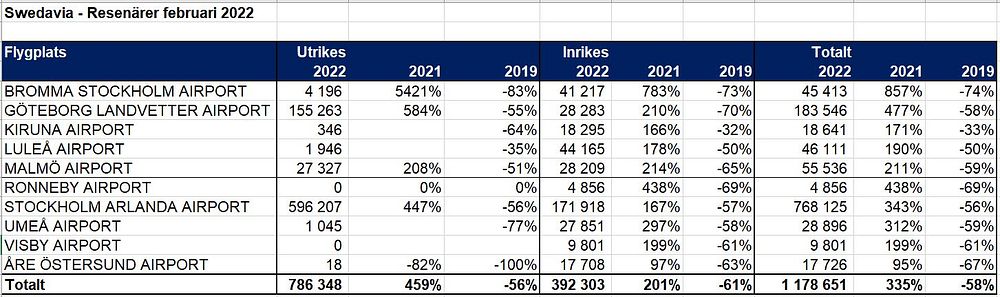


During February, 1.2 million travelers flew at Swedavia's ten airports, a decrease of 58 percent compared to February in the normal year 2019. Compared to February last year, which was also heavily affected by the pandemic, travel increased by 335 percent.
The aviation recovery is gaining momentum in February thanks to the easing of corona restrictions, the reopening of countries, but also increased travel in connection with the sports holidays. The developments in Ukraine and airspace restrictions linked to the conflict have so far had a limited effect on travel.
– After a weak start to the year, air travel gradually increased during February, primarily driven by eased restrictions but also by increased travel in connection with the sports holidays. Continued easing of restrictions, new airline investments at our airports and pent-up travel demand lay the foundation for a strong recovery in the coming months and especially in the summer, says Jonas Abrahamsson, Swedavia's President and CEO.
– In light of the developments in Ukraine, Swedavia would also like to express our deepest sympathy and compassion for the people who are so tragically being affected terribly by the war. Our airports have basic preparedness and well-established cooperation with the relevant authorities to be able to assist in the social efforts that may now be relevant. Airspace restrictions and economic sanctions have so far had a limited impact on air travel, but may of course have a greater impact later on, says Jonas Abrahamsson.
Of the 1.2 million travelers in February, 786,000 were international travelers and 392,000 were domestic travelers. International travel decreased by 56 percent while domestic travel decreased by 61 percent compared to February 2019, before the pandemic. Compared to February 2021, air travel increased by 335 percent in February, but compared to 2019, there was a decrease of 58 percent.
Sweden's largest airport, Stockholm Arlanda Airport, had 768,000 travelers in February, which was a decrease of 56 percent compared to February 2019. In February, international travel decreased by 56 percent compared to the same month in 2019, while domestic travel decreased by 57 percent. Compared to February last year, travel increased by 343 percent in February.
Gothenburg Landvetter Airport had a total of 184,000 travelers in February. This was a decrease of 58 percent compared to February 2019. International travel decreased by 55 percent while domestic travel decreased by 70 percent compared to February 2019. Compared to February last year, the increase in travelers was 477 percent.
Bromma Stockholm Airport had approximately 45,000 travelers in February, which was a decrease of 74 percent compared to February 2019, but an increase of approximately 40,000 travelers compared to February last year when the airport had barely any air traffic.
The other seven Swedavia airports all had a clearly improved passenger development in February compared to February last year, although at levels that were significantly below the number of passengers in February 2019. Kiruna Airport followed by Luleå Airport had the greatest recovery during the month compared to February 2019.
Air travel at Swedavia's ten airports has decreased by almost 63 million passengers since the start of the pandemic 24 months ago.