



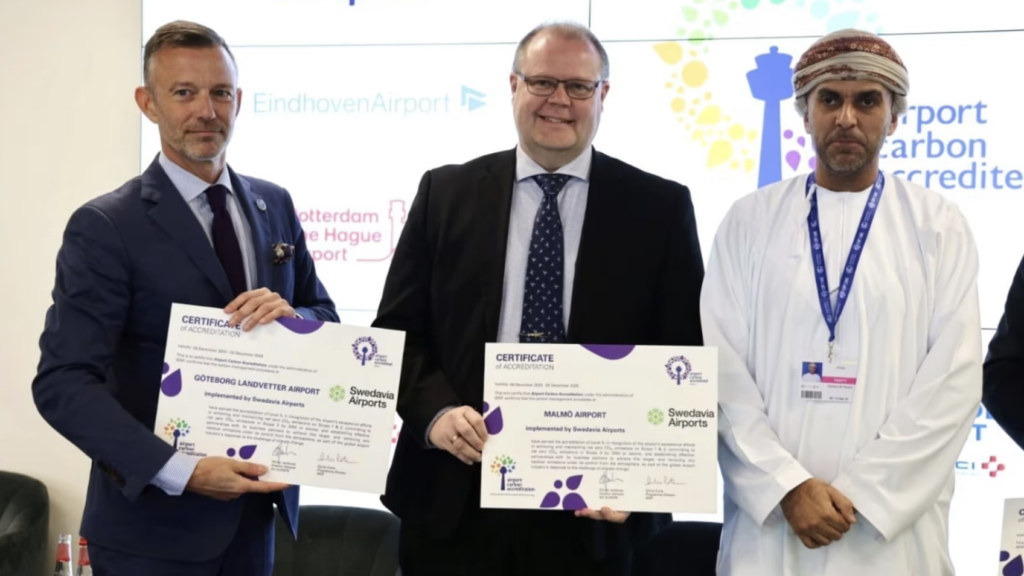
As two of the first ten airports in the world, and the only ones in Northern Europe, Gothenburg Landvetter Airport and Malmö Airport are now certified at the highest level according to the international industry standard for airport climate change work, Airport Carbon Accreditation (ACA). The increased ambition means that the entire value chain in airport operations will eventually have net-zero carbon dioxide emissions, including suppliers and partners. The certificate was presented to Swedavia at a ceremony during the COP 28 climate summit in Dubai.
Already in 2020, Swedavia's own airport operations at all of Swedavia's ten airports became fossil-free, something that Swedavia as an airport operator was the first in the world to achieve. Having achieved and maintaining net-zero carbon dioxide emissions in its own airport operations is a prerequisite for achieving the new certification, which means that Malmö Airport and Gothenburg Landvetter Airport will work to ensure that the entire value chain in the airport operations, including all goods and services that are procured, will have net-zero carbon dioxide emissions by 2050 at the latest.
– The transport sector's climate transition needs to accelerate in order to achieve the goals set in the Paris Agreement. We are world leaders in climate work at our airports and a natural next step in this is to both support and set demands on other actors in our value chain to promote their transition and encourage innovation and climate-smart solutions. The fact that Swedavia is being highlighted as an international role model in the climate area during COP 28 is extremely gratifying and honorable. It is an important incentive to continue our ambitious transition work and to be an active party in the climate transition in aviation that must happen, says Jonas Abrahamsson, President and CEO of Swedavia.
As part of the certification, Swedavia will, among other things, map and report all other emissions at the airports that come from actors other than its own operations. Together with the airports' partners, individual action plans will also be developed, where clear requirements are set in the environmental and climate area in order to conduct operations at the airports.
Swedavia's ambition is for all of the company's airports to be certified at the highest level according to ACA and Stockholm Arlanda Airport will be certified as early as next year.
Malmö Airport and Gothenburg Landvetter Airport are, together with eight other international airports, and the only airports in Northern Europe, the first to be certified at the highest level according to ACA. The new certification was presented during the COP 28 climate conference in Dubai.
In addition to the work of restructuring airport operations, Swedavia is also a driving force in the transformation of the entire aviation industry, which in Sweden means that domestic flights will be fossil-free by 2030 and that all flights departing from Swedish airports will be so by 2045 at the latest.
Facts about Airport Carbon Accreditation (ACA)
- Airport Carbon Accreditation is a framework within Airport Council International (ACI) that evaluates airports' efforts to manage and reduce their carbon emissions and climate impact. The framework has seven levels.
- ACA 5 (Level 5) means that the airport operator must achieve zero emissions of climate-affecting gases from its own operations (scope 1 and 2), which Swedavia achieved in 2020. Zero refers to at least a 90 % reduction compared to 2010. The remaining 10 % must be removed by purchasing emission reductions in projects that remove carbon dioxide from the atmosphere, such as forest growth or carbon capture storage (CCS). In addition, a plan is required in place for how emissions from the entire value chain will reach zero by 2050, in accordance with the Paris Agreement's 1.5 degree goal. Swedavia does this through the partnership plan.
- Stockholm Arlanda Airport was one of 17 airports that joined the framework at its inception in 2009. Swedavia became the first airport group in the world to become fossil-free in its own airport operations by the end of 2020.
- Stockholm Arlanda Airport also became the first airport to receive ACI's newly established ECO Innovation Award in 2010, an award that the airport also received in 2021.
According to the press release.