

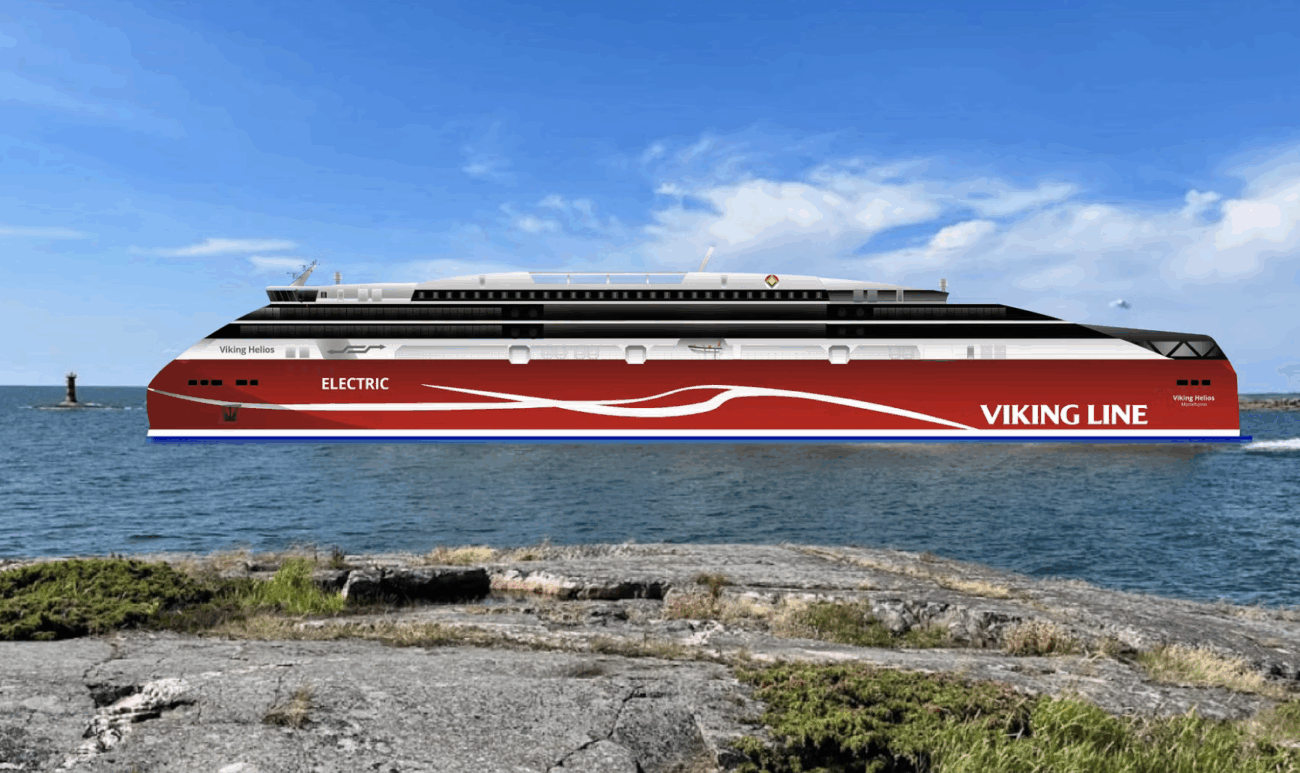
Viking Line is preparing to launch a completely emission-free service between Helsinki and Tallinn. The company's new groundbreaking ship concept is proof that a green shipping corridor across the Gulf of Finland could be realized as early as the early 2030s. The concept, which goes by the name Helios, would be the world's largest electric passenger car ferry when realized.
The Helios ship concept developed by Viking Line presents what the world's largest fully electric passenger car ferry would look like. With a battery capacity of approximately 85–100 megawatt hours (MWh), Helios would be able to transport 2,000 passengers across the Gulf of Finland in just over two hours. The concept ship is 195 meters long, 30 meters wide and has a speed of approximately 23 knots. The cargo capacity on board is approximately 2 km. Compared to the silhouette of traditional ships, Helios is distinguished primarily by the lack of a chimney.
Helios is based on a research collaboration between Viking Line and Rauma Shipyard and a number of other partners. The concept is planned specifically for the Helsinki–Tallinn route, as the 80-kilometer or 43-nautical-mile route is ideally suited for electric ship traffic. The electric ship is always charged when the ship is in port. The ship requires a charging capacity of over 30 megawatt hours.
–Helios opens up the horizons for a new era in shipping, just as the first sailing, steam and motor ships did in their time. The concept proves that large-scale emission-free shipping is no longer a utopia, but the world's largest fully electric passenger car ferries could be in service as early as the beginning of the next decade. We are very committed to making the ambitious vision that Helios represents a reality, says Jan Hanses, CEO of Viking Line.
Over the years, Viking Line has paved the way for lower-emission shipping by investing hundreds of millions in groundbreaking technology. Viking Grace, which was delivered in 2013, was the world's first passenger ship to use both liquefied natural gas and biogas as fuel. In 2022, Viking Glory came into service with even more innovations. Through these ship investments, Viking Line's passengers can now choose biofuel for a surcharge, thereby reducing their journey's emissions by 90 percent. In addition, the first cargo customers have signed agreements to use biofuel.
Emission-free shipping in the Gulf of Finland is promoted by the City of Helsinki and the City of Tallinn's FIN-EST Green Corridor project, whose founders and members also include the Ports of Helsinki and Tallinn, the Estonian Ministry of Climate Change, as well as Viking Line, Rederi AB Eckerö and Tallink Grupp.
The Helios ship concept serves as a basis for further planning and for a request for tender to shipyards. Viking Line has this spring submitted a funding application to the EU Innovation Fund for the construction of a ship.
The Viking Helios concept ship
- Length: Approximately 195 m
- Width: Approximately 30 m
- Power source: Electricity (100 %)
- Battery capacity: 85–100 MWh (charging power requirement >30MWh)
- Speed: Approximately 23 knots
- Passenger capacity: Approximately 2,000
- Passenger cars: Approximately 650
- Shipping capacity: About 2,000 film meters
According to the press release.