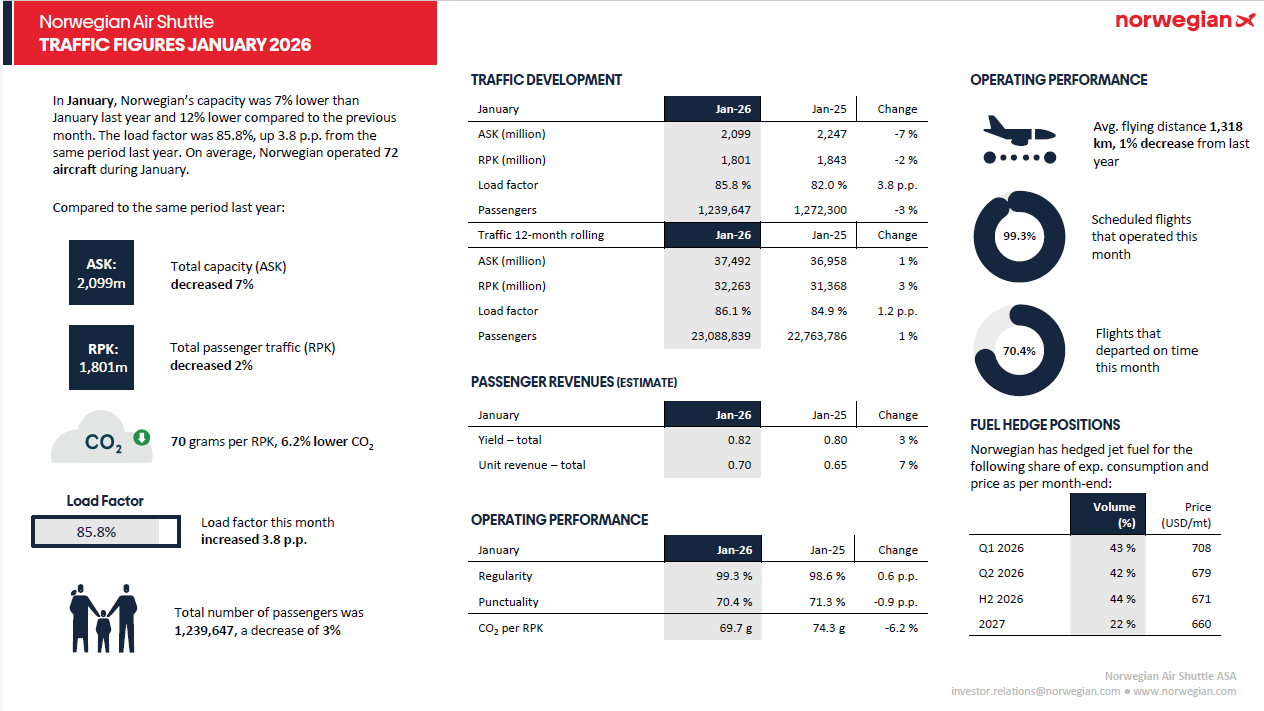




In January, the Norwegian Group had 1.52 million passengers, of which 1.24 million flew with Norwegian and 282,000 with Widerøe. January is normally a month with less travel and capacity was well adapted to the lower demand.
– I am very pleased with the start of the year. Norwegian's capacity has been adjusted to a month with less travel, which resulted in a clearly improved cabin factor of 86 percent. At the same time, unit revenues strengthened, reflecting consistently high demand in our markets, says Norwegian's CEO Geir Karlsen.
Norwegian's capacity (ASK) was 2,099 million seat kilometers, a decrease of 7 percent compared to January 2025. Actual passenger traffic (RPK) was 1,801 million seat kilometers, a decrease of 2 percent from last year. In January, Norwegian had an average of 72 aircraft in operation. The cabin factor was 85.8 percent, an increase of 3.8 percentage points from last year. Regularity, which measures the proportion of flights completed, was 99.3 percent. Punctuality, which measures the proportion of departures that depart within 15 minutes of the regular schedule, was 70.4 percent.
– Demand for flights with Norwegian is still stable. Bookings for the rest of the winter look very good and are at a higher level than the same period last year. It is mainly trips to warmer latitudes that are in demand now, continues Geir Karlsen.
Widerøe's capacity (ASK) was 156 million seat kilometers, a decrease of 1 percent compared to last year. Actual passenger traffic (RPK) was 100 million seat kilometers, a decrease of 7 percent compared to January 2025. The cabin factor was 64.2 percent, a decrease of 4.2 percentage points compared to last year. Regularity, which measures the proportion of flights carried out, was 96.5 percent. Punctuality, which measures the proportion of departures that depart within 15 minutes of the regular schedule, was 85.7 percent.