



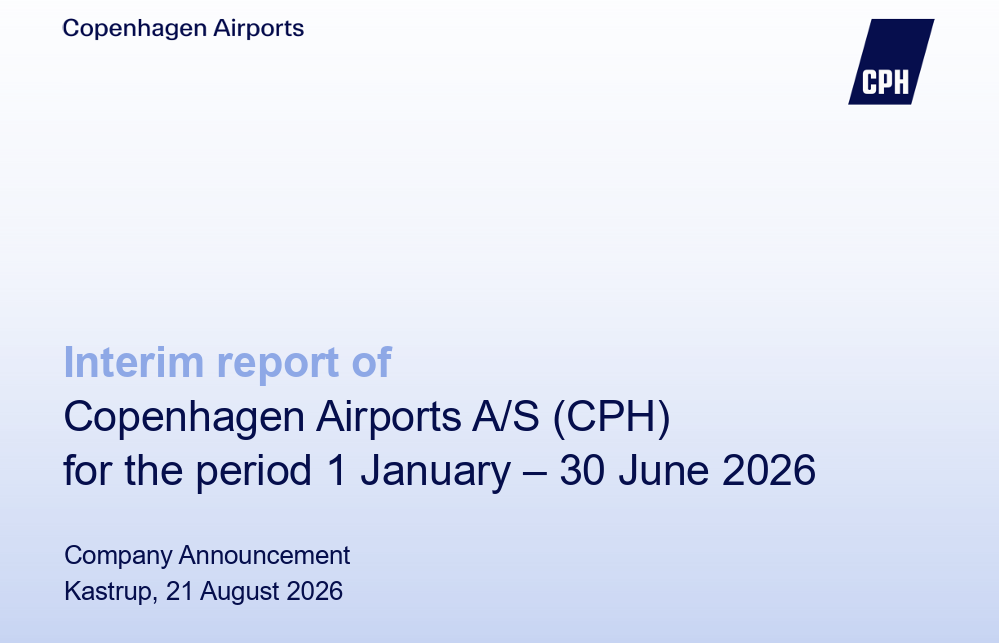
Copenhagen Airport continues to grow strongly. In the first half of 2026, a record 16.1 million passengers traveled through the airport, while pre-tax profit rose to DKK 851 million. Transfer traffic in particular is growing rapidly.
The number of passengers increased by 9 percent compared to the same period last year and reached the highest level so far for a first half of the year.
“This is the highest number of passengers at the airport ever. Global travel demand remains high despite rising fuel prices, and more passengers are choosing to fly via Copenhagen,” says Christian Poulsen, CEO of Copenhagen Airports.
Financially, the first half of the year was also strong. Pre-tax profit amounted to DKK 851 million, 43 percent higher than the previous year. However, the result was not only driven by passenger growth but also by the sale of the airport's share in Smarter Airports.
Turnover increased by 9 percent to DKK 2.8 billion. Revenue from air traffic itself rose by 11 percent to DKK 1.72 billion, while revenue from shops, parking, hotels and real estate, among other things, increased by 6 percent to DKK 1.05 billion.
Transfer traffic increases by 31 percent
An important explanation for Copenhagen's growing importance as a Nordic aviation hub is transfer passengers.
During the first six months of the year, 4.3 million passengers changed flights in Copenhagen, an increase of 31 percent. Transfer passengers now account for 27 percent of all passengers at the airport.
A large proportion are Danish, Swedish and Norwegian travellers who continue on to Europe, North America and Asia. At the same time, the number of American and Asian travellers using Copenhagen as a gateway to Europe is increasing.
“Transport traffic is absolutely crucial for Denmark. It makes it possible to open and maintain direct routes to the rest of the world,” says Christian Poulsen.
Billion-dollar investments in the airport
At the same time, growth means a need for greater capacity. During the first half of the year, the airport invested DKK 1.17 billion in, among other things, terminals and aircraft parking areas.
In 2027, a new area in Terminal 3 will open with expanded passport control and baggage handling as well as more space for restaurants, shops, lounges and passengers.
The airport is also investing in reducing its environmental impact. Among other things, AI and thermal imaging cameras are used to check that aircraft auxiliary engines are turned off at the gate. In addition, 18 sensors were installed in the spring of 2026 to continuously measure ultrafine particles.
Middle East traffic is decreasing
The development is not positive in all markets. Traffic between Copenhagen and the Middle East decreased by 30 percent in the first half of the year to 310,000 passengers, 140,000 fewer than the previous year.
The conflict in the Middle East has also contributed to higher oil and jet fuel prices. However, according to the airport, fuel prices had no significant effect on overall traffic during the first half of the year.
Lowers passenger forecast – raises profit forecast
Demand growth has started to slow, and Copenhagen Airport is therefore lowering its full-year forecast from 35.5 to 34.5 million passengers. This would still represent a significant increase from 32.4 million in 2025.
At the same time, the forecast for this year's profit before tax is being raised. The airport now expects DKK 1.80–1.95 billion, compared to the previous DKK 1.75–1.90 billion.
Sales are expected to increase by around 7 percent for the full year 2026.