



Results might surprise frequent travellers: several full-service airlines rank higher
some so-called low-cost airlines when the real cost is examined.
The ranking is based on RASK (Revenue per Available Seat Kilometre), an industry measure
which shows the airline's revenue per seat and kilometre, including all fees and surcharges.
By using RASK, consumers get a more realistic picture of what travellers actually
pays and can see which companies are truly the most cost-effective.
– Our annual ranking examines the overall cost and reveals which airlines truly are
affordable and which ones are just marketing themselves as such, explains Anton Radchenko, CEO of
AirAdvisor.
Europe's most affordable airline 2025
- Wizz Air
- Tap Air Portugal
- SAS Scandinavian Airlines
- Norwegian Air Shuttle
- Finnair
- KLM
- Iberia and Vueling (shared seat)
- Aegean Airlines
- Ryanair and Air France (shared seat
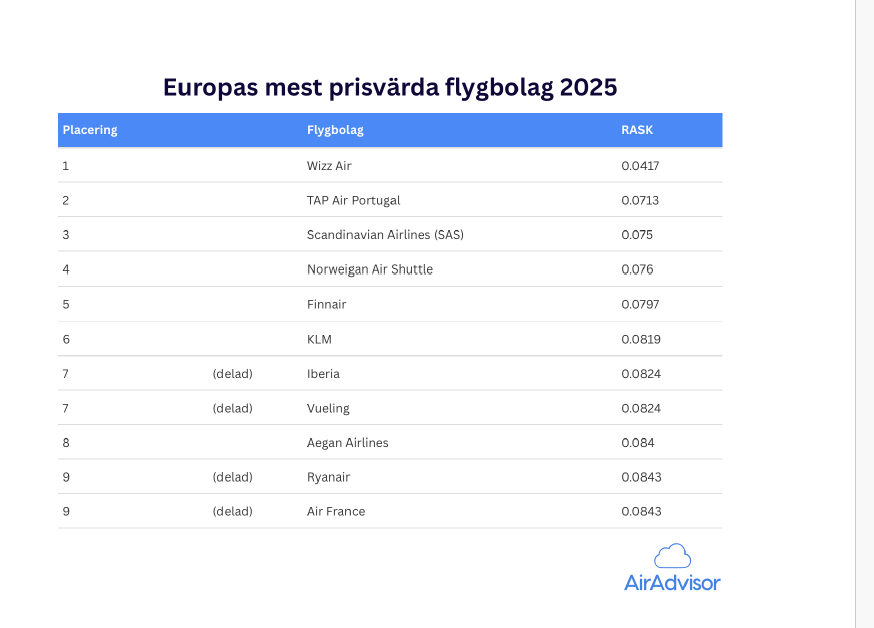
Studies show clear differences in value for money between different airlines. SAS ranks third
cheapest in Europe, showing that full-service companies can sometimes offer better value than some
low-cost airline. Wizz Air is still by far the most affordable option,
TAP also performs strongly in terms of real value.
However, Ryanair, which is often marketed with extremely low ticket prices, ends up at the bottom
on the list. The many extra charges quickly make the total cost significantly higher
at the advertised price.
SAS, on the other hand, achieves a more favourable result when looking at the balance between what they take
paid and what they offer per passenger kilometre. This doesn't mean all their tickets are
cheaper than Ryanair's, but thanks to its pricing structure and operational efficiency, it can
they offer a lower average cost.
– It’s easy to be tempted by low ticket prices, but it’s important to look at the overall cost. A ticket
at 100 kronor can quickly rise to over 990 kronor when you add hand luggage,
seating choices and the opportunity to sit together as a family, says Radchenko.
Why is this ranking relevant right now?
Airlines are introducing new charges at a faster rate today than they are lowering their prices and fares.
which seem cheap at first glance can become significantly more expensive when options and extras
costs are factored in. Families are hit particularly hard, as gate fees can often be
be both unexpected and high.
At the same time, consumer awareness is increasing that the price of a flight ticket is not always
reflects the true cost. In the same way that some shops have previously increased
prices ahead of sales to show bigger discounts, can airlines' low starting prices
quickly become misleading when all fees are added.
Consumer advice: How to find the cheapest flights
- Compare prices carefully between different airlines, taking into account any additional fees.
and check the total cost of the ticket before booking. - Be flexible. Changing your dates or destination can significantly lower the price.
Calendar tools can help find the cheapest days and routes. - Subscribe to newsletters. Many airlines that share their best offers first
with its subscribers. - Read the terms and conditions. Extra charges and cancellation policies for low-cost flights can be surprising, so it's important to
it is important to read them carefully. - Act fast. Genuine flight deals rarely last long, and the best sales
often disappears in just a few minutes.
If your find goes wrong
If your flight is disrupted, EU regulation 261/2004 may entitle you to fixed compensation of €3,000 - €7
£600 (depending on flight distance) on arrival for delays of over 3 hours, cancelled flights
or denied boarding with the exception of extraordinary circumstances. You also have
Right to care (meals, refreshments, and accommodation if necessary).
If your checked baggage is lost, damaged or delayed, the airline's liability is regulated.
according to the Montreal Convention, up to 1,519 SDR per passenger (approximately £17,700),
including reimbursement for necessary purchases while you wait. To ensure you receive
For compensation, you should complete a Property Irregularity Report (PIR) at the airport and subsequently
submit a written claim. For damaged luggage, the claim must be submitted within seven days, and for
delayed baggage for up to 21 days from the day the baggage is delivered.