
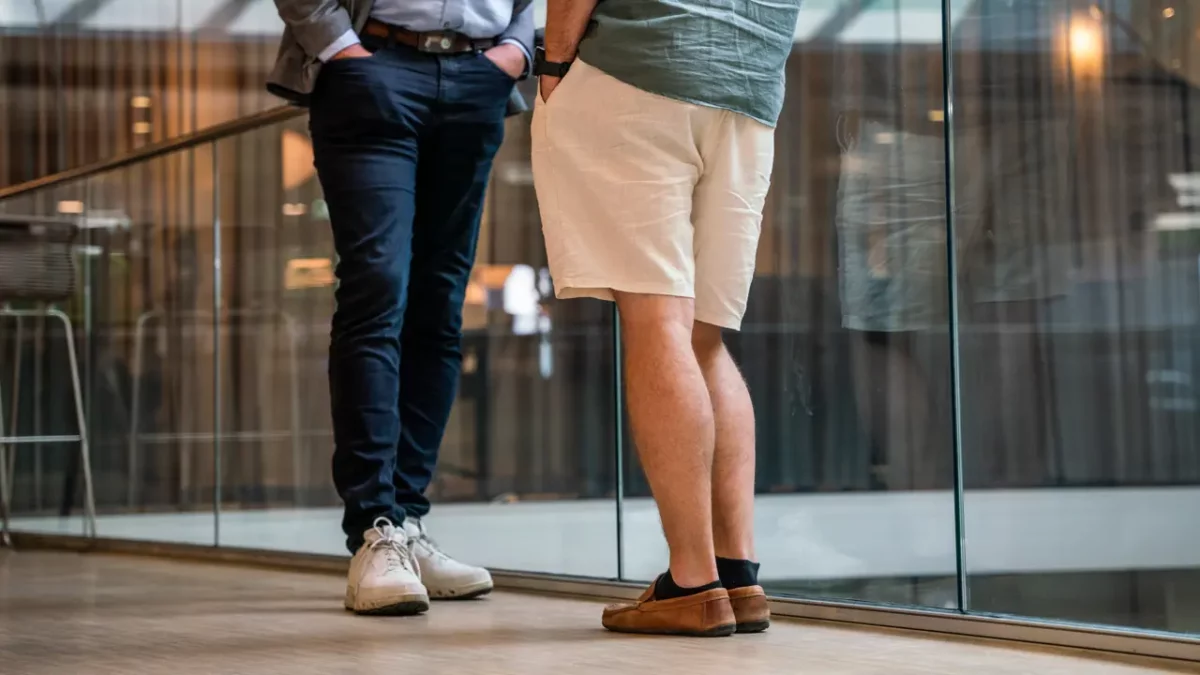
Sunny days and rising temperatures make Swedes throw off their clothes, but should you as a manager say no to shorts at work?
I Aftonbladet Today the annual debate comes up. This garment that is both loved and hated in working life – shorts.
Employers can, as a starting point, control dress codes in the business, says Fredrik Christiansson at Simployer, and thereby prohibit employees from wearing shorts, tank tops, caps and sunglasses, for example.
-In Sweden, there is no law that regulates dress codes (except for protective clothing), it is up to the employer to control, emphasizes Anna Schönfelder, one of Simployer's HR and labor law experts.
Unwritten rules
In 2018, it made headlines across Europe when the editor of the Danish newspaper Jyllands-Posten banned shorts at work. ”We are a workplace – not a campsite,” was the message to employees. And in the UK, the dress code is often a suit and tie, with unions encouraging employers to give employees a little “slack” when the temperature approaches 30 degrees. Here at home, however, an official dress code is something that few workplaces have. Outside of those industries where the dress code is linked to health, safety and environment, it is largely up to the individual employee to choose their own attire, says Anna, continuing:
"Employers have relatively large opportunities to regulate how employees should dress in the workplace, but religious freedom must be taken into account. Dress codes are most often regulated in internal guidelines," says Anna Schönfelder at Simployer.
-We know that it is precisely in our differences and differences that we create a pleasant and happy workplace, which is why I urge employers not to step in and control dress codes unless there are requirements or it is purely practical, says Fredrik and continues:
– In our time, individual expression is emphasized and celebrated in terms of both appearance and clothing. The conflict between the employee's desire to stand out and the employer's demand for consistency may therefore become greater in the future than it has been in the past.
Talk dress code
On the hottest days of summer, the discussion reawakens, it's not always easy to know what's going on and the shorts debate heats up in workplaces. Of course, it can be good to prevent the discussion.
But here, HR and labor law expert Anna emphasizes that it is better to have dialogue between leaders and employees. Dialogue increases transparency and if guidelines are needed, it is wise to arrive at them together.
It is usually good to start from what you want to achieve with a possible dress code and assume that employees are wise and adults who know best what is appropriate for each given occasion. Tank tops and swimming shorts are perhaps more appropriate on the beach than in a customer meeting, concludes Fredrik Christiansson at Simployer.
According to the press release.