





It is a milestone in the development towards future fossil-free flying in Sweden.
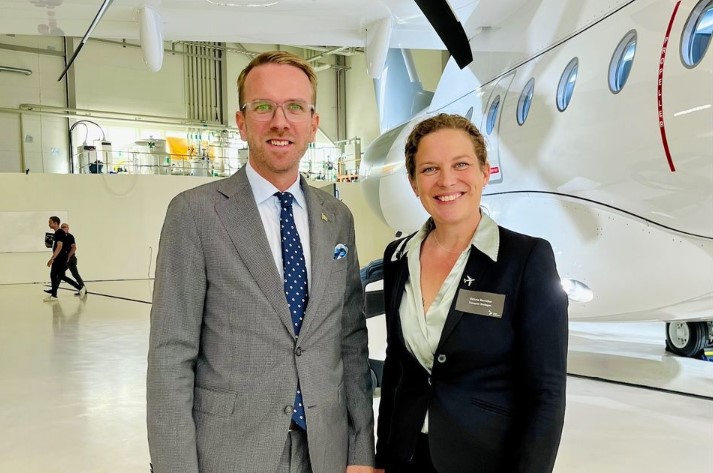
Heart Aerospace, a member company of Transportföretagen Flyg, is displaying a full-scale model of its electric hybrid aircraft ES-30 for the first time in their hangar at Säve Airport in Gothenburg. Heart Aerospace is a world leader in electrified regional aviation.
– The aviation transition stands firmly on several legs that complement each other. Sustainable aviation fuel already exists and works today in existing aircraft. Small electric aircraft already exist and larger planes like the ES-30 for commercial use are in the works within just a couple of years. In the slightly longer term, we also see hydrogen as part of the solution, and it is likely that further opportunities will emerge along the way, says Marcus Dahlsten, CEO of Transportföretagen.
– Today we can literally take on the fossil-free future of aviation and it feels obvious that it is happening in Sweden. We have a unique opportunity to be a global leader in fossil-free aviation, with our long history of a strong aircraft manufacturing industry and as a pioneer in the transition to a more sustainable aviation. To get there, we need, in addition to research and development, also support to move from development to industrialization, says Victoria Barrsäter, business policy expert at Transportföretagen Flyg, who was on site to see the aircraft.
Minister of Housing and Infrastructure Andreas Carlson attended the event and expressed his and the government's appreciation for Heart Aerospace's pioneering work in electric aviation. Within a few years, it will form an important part of the Swedish aviation system. The government also got to fly a small electric aircraft during the morning.
Industry meets goal of fossil-free Nordic airlines
Recently, the Nordic infrastructure ministers signed a joint declaration that will pave the way for fossil-free flights in the Nordic region by 2030 and specifically support the introduction of electric flights in the Nordic region. With the presentation of ES30 today, the industry is meeting with the technology that will enable the intentions behind the declaration.
Fredrik Kämpfe, Industry Manager at Transportföretagen Flyg, has been involved since Heart Aerospace showed its first concept aircraft, the ES19, in September 2020, in the presence of HRH Prince Daniel and then Minister of Infrastructure Tomas Eneroth. He sees great opportunities with the ES30 both for aviation and for Sweden, but emphasizes:
– In order for us to reach the potential of electric aviation, we must now invest broadly. Regions, municipalities and government actors must cooperate to prepare the market for the electric aviation of the future. This is when we must take the important steps. When we start production of the ES30 and at the same time invest in the necessary ground infrastructure, we will be able to open up both existing and new flight routes with this climate-smart aircraft. At the same time, a new and important skills industry is being built up in the country that will strengthen Sweden as an export nation and a node for aeronautical expertise in the world. This is absolutely crucial for a geographically large but sparsely populated country like Sweden, says Fredrik Kämpfe, Industry Manager at Transportföretagen Flyg.
The transition to fossil-free aviation is already underway through a variety of initiatives within the aviation industry. In Sweden, the work is based on the ”Roadmap for fossil-free competitiveness: Aviation industry”, which is part of the work within the government initiative Fossil-free Sweden. The goal is to achieve fossil-free domestic aviation by 2030 and for all flights, both domestic and international, departing from Swedish airports to be fossil-free by 2045. On September 17, an update of the aviation fossil-free roadmap will be submitted to the Minister of Housing and Infrastructure, Andreas Carlson.
Facts Aerospace ES-30
The new technical configuration of the Heart Aerospace ES-30 means that it is a hybrid-electric aircraft that can carry up to 30 passengers and 25 kg of luggage per passenger. It has two electric motors for short flights of up to 200 km on battery power alone. For longer flights, up to 400 km, two small turboprop engines are activated to act as a backup and extend the range. The engines can run on sustainable aviation fuel. With 25 passengers, the range is up to 800 km. The batteries, which have been moved to the rear of the fuselage for better efficiency, charge in just 30 minutes. The aircraft can take off and land on shorter runways, opening up opportunities for use at smaller airports. The ES-30 should be certified and ready to start flying passengers in 2028.