



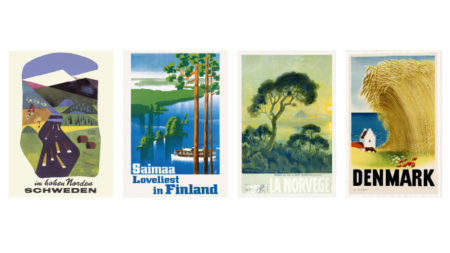
The exhibition opens on March 11th. Come to the North at the Nordic Museum. The exhibition shows classic travel posters from the 1890s to the 1960s that tell the story of the emerging tourism within and to the Nordic region. The posters show how the Nordic countries positioned themselves on the tourist map and reflect some crucial factors for tourism: leisure, welfare and holidays – and the dream of traveling.
The exhibition presents nearly 130 original travel posters from Finland, Sweden, Denmark, Norway and Iceland from the 1890s to the 1960s and is now being shown together for the first time. They were created by poster artists and advertisers who painted a picture of the Nordic region as a traveler's paradise. In connection with the growth of the travel industry, a new branch of art emerged, the illustrated travel poster, which flourished until the 1960s. Marketing attracted with comfortable travel on water and magnificent nature with mountains, fjords, lakes and small capitals with historical attractions.
– Come to the Nordics is a visual and fun exhibition that, through its variety of advertising images, illustrates a romanticized Nordic region, as it was presented to the world from the 1890s to the 1960s. During this time, the Nordic region was modernized and emerged as ideal countries for democracy, cleanliness, nature and health. The exhibition also shows that it was popular to travel within the Nordic region early on: the exotic was close at hand. The posters have a renewed relevance today in light of the fact that more and more people today want to travel more sustainably and discover the Nordic region., says True Houby-Nielsen, board member of the Nordic Museum Foundation.
Modern travel – travel for pleasure – is a child of the bourgeois travel culture of the 19th century. Before the First World War, only the well-off traveled, but in line with holiday legislation and changing consumption patterns, more and more people were able to travel for pleasure. Tourist travel, which was first done on foot and by horse and carriage, took the route by train and steamboat in the mid-19th century and then by car and plane. Not only did distances shrink, but also travel time. The posters make visible an incipient leisure travel that grew in pace with social development, technology, holiday legislation and democratization. Tourism and holiday celebrations are a typical 20th century phenomenon.
Today, the Nordic countries, like the rest of the world, are facing questions about what a future of sustainable travel might look like. Discussions about travel and flying arouse strong emotions, and in the wake of the pandemic, interest in homestays has increased.
Poster competition calls for new interpretations
A competition is being held ahead of the exhibition.My Nordic Poster 2022 which calls for new interpretations of the classic travel poster that highlight sustainable travel and the Nordic region as a destination. During the period 11–25 February, the public is welcome to vote for the finalists on cometonorden.com.
The final images are finally displayed in the exhibition as a contemporary commentary on the classic travel posters.
The jury consists of Linda Bondestam, illustrator, Vanessa Gandy, Nordic Museum Foundation, Andreas Kittel, graphic designer, Magnus Londen, Come to Finland and Sabina Westerholm, Nordic House in Reykjavik.
The exhibition Come to the North will be on display in the Great Hall at the Nordic Museum in Stockholm from 11 March to 6 November 2022. The exhibition is a travelling exhibition and is produced by the poster companies Come to Sweden and Come to Finland together with the association Affischjägarna in collaboration with the Nordic Museum. At the initiative of the Nordic Museum, the exhibition shows travel posters from all over the Nordic region.
Since 2020, the museum has been working on its largest exhibition initiative ever – a new main exhibition planned to open in 2023 in conjunction with the museum's 150th anniversary. In 2022, floor 4 will be closed to carry out historically extensive work to improve the museum experience, accessibility and infrastructure.