



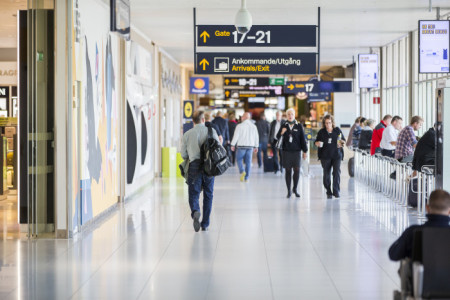
Domestic flights continue to lose passengers.
During January, around 50,000 fewer passengers flew via Arlanda in Stockholm compared to last year, which is a decline of 12 percent. In Gothenburg and Malmö the loss is even greater.
”"We see continued weak development," says Charlotte Ljunggren, Swedavia's Marketing Director.
But it is far from flight shame that is behind this development, she believes.
All ten airports owned by state-owned airport operator Swedavia had declining passenger numbers in 2019. January 2020 shows that the declining flight trend continues.
A total of 2,670,000 people travelled via Swedavia's ten airports during the month, which is a decrease of 6 percent. But when it comes to domestic flights, the drop is greater, 11 percent. Here, it is primarily the three major cities, Gothenburg, Malmö and Stockholm, that have felt the biggest declines. In Gothenburg and Malmö, domestic travellers decreased by 20 and 18 percent respectively during January. A development that worries Swedavia's Marketing Director Charlotte Ljunggren.
”"Accessibility is decreasing throughout Sweden, but especially from and to the large hubs, which fly to places like Heathrow and Frankfurt. If you don't get the frequency on domestic flights, the opportunity to get out into the world is decreasing."”
Charlotte Ljunggren sees several explanations for the decrease in Swedes' flying. The climate, which has gained increasing space in the debate, is one of them, but also that workplaces have shifted in their way of working and have less need for flying. The construction boom in 2017 started a downward travel trend where workplaces were fully occupied in their local markets, so much so that consultants and engineers did not have to commute to other cities to the same extent, says Charlotte Ljunggren.
”"We saw this trend continue in 2018, while digital tools took hold and many people started having every other meeting via Skype and every other meeting on site."”
In 2019, the climate has come into even greater focus, which has contributed to several workplaces changing their travel policies, something that has colored the figures. At the same time, a slowdown in the economy is visible.
”"Then you take the opportunity to write new types of travel policies. The counter-effect of this is that airlines reduce their supply. If I look at Gothenburg, the supply has been reduced by almost a quarter. In Malmö, Norwegian left, which has led to a quarter disappearing from the market there as well."”
Charlotte Ljunggren describes the current situation as challenging and tough, with aviation taxes and a weak krona dampening development. At the same time, she sees bright spots in international flights, with Landvetter being an example of an airport where passenger numbers have increased; in January, 3 percent more people traveled via Landvetter and out into the world compared to last year.
”"There, international travel continues to increase, largely due to low-cost airlines. Ryanair continues to invest in Western Sweden, which is positive. Qatar has also increased its departures. This is driving traffic and is related to the economic situation in Western Sweden, which we see is strong with many international companies."”
Many still see flying as one of the biggest environmental offenders. What are the best arguments for taking the plane and not the train today?
”"If we don't take the plane today, there won't be a plane tomorrow. We are world leaders in running climate-smart airports and receive visits from others who are looking at how we do it. We have submitted a roadmap for a fossil-free Sweden, if there is anyone who should lead the way, it is Sweden when it comes to that transition. We are already far ahead and an incredibly important part is the transition to biofuel, which we will of course be the first to produce."”