



Europe is the continent where warming is happening the fastest, with temperatures rising about twice as fast as the global average. The three warmest years for Europe have all occurred since 2020 and the ten warmest since 2007, according to the European State of the Global Climate 2023 report.
It is the Copernicus Climate Change Service (C3S) that, together with the World Meteorological Organization WMO, is today releasing the report European State of the Climate 2023. The report is an analysis of climate change, important events and its effects.
The report European State of the Climate 2023, on the WMO website
”"Important to have decision-making data for reducing climate impact and for work on climate adaptation"”

Climate change affects all parts of society, and all individuals. We need to monitor the climate through observations and analyses, and this type of report is important to provide a comprehensive picture of developments. We also need to conduct further research and further develop our climate information. Through increasingly advanced calculations, we can provide society and individuals with images of the future climate, which is an important basis for decision-making both for reducing climate impact and for work on climate adaptation, says Erik Kjellström, professor of climatology at SMHI.
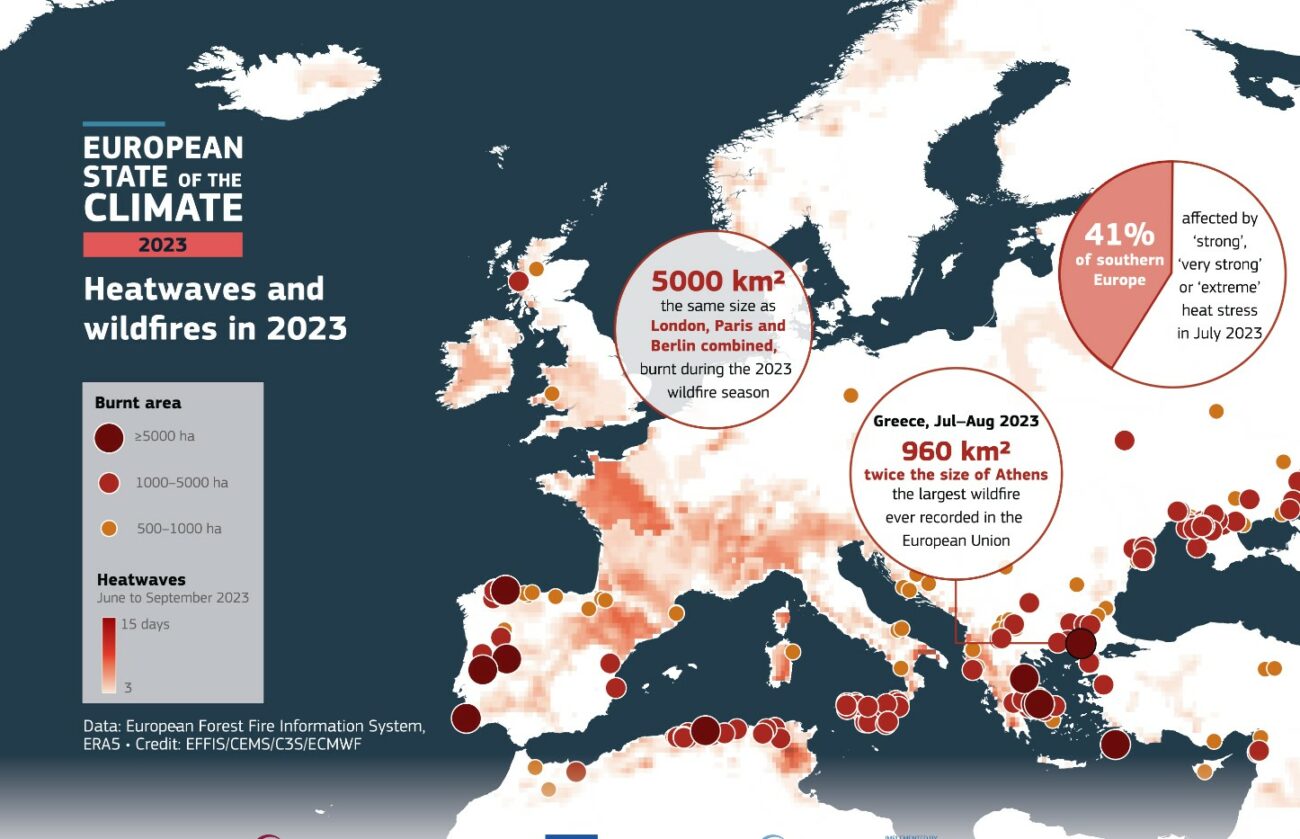
Carlo Buontempo, Director of the Copernicus Climate Change Service, comments on the European State of the Climate 2023 report in a press release: ”In 2023, Europe witnessed the largest forest fire ever recorded, one of the wettest years, severe marine heatwaves and widespread devastating floods. Temperatures continue to rise, making our data increasingly important for preparing for the impacts of climate change.”
Negative health effects resulting from extreme weather and climate events
The number of negative health impacts related to extreme weather and climate events is increasing, according to the Copernicus and WMO report.
Extreme heat, torrential rain and drought can all have negative consequences for human health. It is therefore important to have a high level of awareness of this, to have early warning systems and to ensure that society is well prepared. It is also important to continue developing tailored climate services for the health sector, points out Erik Kjellström.
2023 the warmest or second warmest year
In the report, the Copernicus Climate Service and WMO summarize facts about temperatures in Europe in 2023:
- 2023, despite near-average temperatures in the north, was the warmest or second warmest year on record in Europe, depending on which dataset is used.
- In 11 of the months of 2023, Europe's average temperature was above the 1991-2020 average, including September, which was the warmest September on record.
What was the temperature in Sweden in 2023? Relatively speaking, it was warmest in Götaland, while northwestern Svealand and southwestern Norrland had a temperature deficit compared to the normal period 1991-2020. Elsewhere in the country, the annual average temperature was close to normal.
SMHI's summary of the weather in Sweden in 2023
Europe the continent warming fastest
The report presented by the Copernicus Climate Service and the WMO points out that Europe is the continent that is warming the fastest in the world, with temperatures rising approximately twice as much as the global average.
The faster warming in Europe is due to several things. A fundamental factor is that the continents are warming faster than the oceans. In addition, a reduced amount of air pollution over Europe has affected the situation. The cooling aerosol particles that previously kept the temperature down, especially during the summer months, have decreased, says Erik Kjellström.

Source: SMHI