



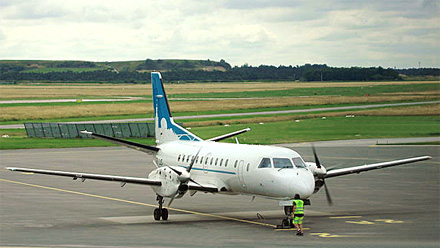
Old Saab planes have been given a role in the development of electric aviation. A project in Australia will convert Saab 340 planes to electric power.
Rebuilding is faster and cheaper than investing in completely new electric aircraft, according to the players behind the initiative.
The Saab 340 is a propeller plane that ceased production in 1999. It has around 30 seats for passengers, and is therefore the right size for the development of electric aviation.
Electric planes are primarily interesting for traffic on fairly short distances, given the range of battery operation.
There is quite a lot of regional air traffic in Australia. Rex Airlines owns around 60 Saab 340s, and now wants to convert one of them to electric operation, as a first step. The project is being carried out in collaboration with, and on behalf of, the electric aviation company Dovetail.
Dovetail expects to have a converted, electric aircraft type-approved within four years, according to a press release announcing the venture in July. It is a fast and cost-effective path towards making zero-emission aircraft commonplace, the Australian players claim.
But not everything will be easy. For example, the original plane's fuel tanks, which are located in the wings, must be replaced with battery packs.
”Integrating battery packs into the wings in the same way as liquid fuel is likely to be challenging or less desirable,” says Hampus Alfredsson, who researches electromobility at the state research institute Rise.
Batteries are heavier than jet fuel, and battery packs are likely to take up more space than required for the fuel tank. So you may need to think in other ways.
”"Should we hang the batteries as "extra modules" under the wings, or expand the fuselage, or should we put them inside the aircraft itself, which actually means taking up some of the passenger space," Alfredsson ponders.
The weight of the batteries is partly offset by the fact that electric drive systems are more energy efficient than combustion engines.
”You can build electric motors that are quite small, but still very efficient. It opens up new types of aerodynamic designs.”
”"Some are saying that in principle you can fill the wings with many small electric motors, so-called distributed propulsion," says Hampus Alfredsson.
A jet engine, on the other hand, can be said to be more efficient the larger it is, he points out by way of comparison.
The project in Australia is not alone in converting a traditional aircraft model to electric power.
”There are some tests underway on this,” says Hampus Alfredsson.
Models for shorter routes are interesting – and also seaplanes, which generally do not need to fly long distances.
The advantage of re-engineering, rather than constructing completely new electric aircraft, is that the airframe itself is already certified for use in commercial traffic. But there is of course a downside.
”You may not have all the freedom to take advantage of the properties that electric drive and electric motors entail,” says Hampus Alfredsson.
At the same time, development of completely new electric aircraft is also underway, including at Heart Aerospace in Gothenburg.
Saab is aware of the initiative in Australia, but does not want to provide any further comment.
”"We are currently not involved in the project that Rex is conducting in Australia to electrify its fleet of Saab aircraft. However, creating sustainable fuels for the aviation industry is something that Saab is actively working on within the framework of other initiatives, and we are ready to assist Rex with our expertise if desired," writes Stefan Eriksson, business unit manager at Saab Aviation Services, in an email to TT.
Source: TT-DI.SE