



| With a pre-tax profit of DKK 167 million in a busy second quarter, Copenhagen Airports A/S has turned the winter's pre-tax loss into a total half-year profit of DKK 108 million. There were 12.4 million passengers through the terminals in the first half of the year – 14 percent fewer than in 2019. The outlook for 2023 has been revised upwards. |
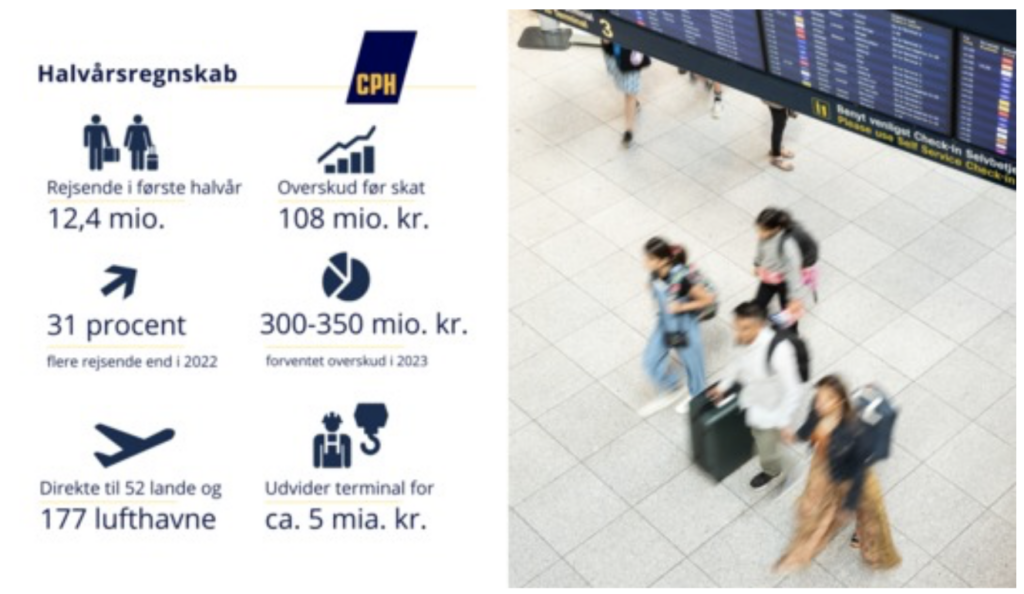
| Copenhagen Airport ended the first six months of the year with a satisfactory financial result under the current circumstances and with an organization ready to welcome passengers during the busy summer. During the first six months of the year, 12.4 million passengers passed through the airport, which is 31 percent more than the previous year. However, this is 14 percent fewer than in 2019 before the COVID-19 pandemic. With the increasing activity in the spring, the second quarter ended with a pre-tax result of DKK 167 million. Excluding the first quarter's loss of DKK 59 million, the half-year ends with a pre-tax profit of DKK 108 million. "Given the circumstances of a demanding restart after COVID-19, this is a satisfactory half-year result. However, the absolute level is not high enough in relation to the necessary investments and our inevitably rising costs,” says CEO Thomas Woldbye. Revenue in the first half of the year amounted to DKK 1,898 million, which is an increase of 22 percent compared to 2022. ”The good news is that the airport is back at full strength organizationally, so that we can deliver good service and performance to passengers, airlines and customers. We hired 372 employees until June, of which about half were filled. This meant that we were ready for the busy summer,” says Thomas Woldbye. Since the low point during the COVID-19 crisis two years ago, more than 3,600 employees have been rehired in the 800 companies in and around the airport, so that around 16,500 people are currently working. Investment of NOK 1.6 billion In April 2023, Copenhagen Airport completed negotiations with the company's lenders on new credit facilities amounting to DKK 7 billion, so that security has been obtained to be able to refinance in August. At the same time, a solution must be found this year for the future tariffs that airlines must pay to use the airport from 2024. With a solution, the airport and the airlines will have predictability in operations in the coming years and a common platform for cooperation on, for example, route development and efficient operation. This year, Copenhagen Airport expects to invest DKK 1.6 billion, mainly in the development of the terminal area between gates B and C with, among other things, significantly more space for passengers and passport control and more than doubling the area for baggage claim in Terminal 3. The project, which costs a total of approximately DKK 5 billion, is the largest at the airport in recent times. The first parts of the construction are expected to be completed in 2027. – However, it is a challenge that it has become significantly more expensive to operate and develop the airport. This is due, among other things, to increased costs for salaries, increased legal requirements and interest and amortization on our debts. Therefore, we must continue to operate the airport as efficiently as possible and constantly work to control costs, emphasizes Thomas Woldbye. The green transition is underway The work on the green transition of the airport and the entire aviation industry is also ongoing, even though the Covid-19 crisis hit hard. “Reducing climate pressure is a fundamental task for the entire aviation industry,” emphasizes Thomas Woldbye. The path to this goal involves, among other things, installing even more solar cells, significant savings of 3 percent annually on energy and heat, investments in electric charging infrastructure and replacing gasoline and diesel equipment and vehicles with electricity. This spring, CPH received the highest recognition in the so-called ACA program, Airport Carbon Accreditation, for its work on CO2 reductions. The line network is close to being rebuilt When it comes to airline routes to and from Copenhagen Airport, the network is well on its way to recovery. This summer, there are 177 direct routes to 52 different countries. This is close to the 2019 level, when there were direct routes to 196 airports in 59 countries. “Both Danes and southern Swedes once again have plenty of opportunities to travel around the world – and Denmark is once again open to the millions of foreign tourists and business travelers who fly here this year,” says Thomas Woldbye. On average, more than seven out of ten airline seats are sold. The cabin factor is therefore at the same level as before 2019. On long-haul routes out of Europe, Asia, and especially China, is still lagging behind. Around half of the passengers are missing here. On routes to North America, the network is busy and close to recovery. Adjusted expectations for 2023 The increasing activity in the spring meant that Copenhagen Airport issued an announcement on 11 July that it had revised its expectations for the rest of the year upwards. The expectations for the number of passengers were revised upwards from over 25 to over 26 million. In addition to the growing activity, the reason for the upgrade is also the agreement between Naviair and the air traffic controllers, which has reduced the uncertainty about how many flight operations can be carried out at Copenhagen Airport. If the number of passengers reaches 26 million Danish kroner, the profit before tax is expected to be 300-350 million Danish kroner. In the last year before Covid-19 hit, Copenhagen Airport achieved a profit of 1.3 billion Danish kroner before tax. According to the press release |