
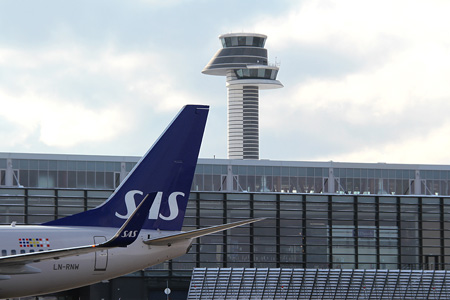
Photo: Mats Montner
The employer organizations are outraged after the SAS boss's statement that the wage agreement with the striking pilots landed on the so-called mark.
It could fuel wage demands from others, believes Anders Weihe, the head of negotiations for the Swedish Technology Companies.
After a week of strike, SAS came Sand the pilots agreed on a new three-year salary agreement, which according to SAS CEO Rickard Gustafson remains "totally within the so-called mark for the Swedish labor market.".
”That information is completely incorrect,” says Anders Weihe.
All employers' associations within The Confederation of Swedish Enterprise agrees that it violates coordination to contribute to exceeding the mark, according to Weihe.
The salary mark for this year is 2.3 percent, which is what everyone else in the labor market has agreed on. SAS pilots received 3.5 percent. For 2020 and 2021, there is no mark yet, the competitive industry will set it, according to the rules that have applied to the Swedish labor market for the past 20 years or so.
”Then, according to our internal rules, it is not permitted to make any agreements,” says Anders Weihe.
He points out that the rate of wage increases would rather have to decrease in future wage agreements in the Swedish labor market, something he does not receive any support from the unions on this particular issue. The SAS agreement goes in the exact opposite direction.
Weihe has spoken to his most important counterparts, IF Metall and Unionen, and says he has them on board with his view on the matter. Unionen's head of negotiations, Niklas Hjert, confirms this at least in part.
”"There is no mark yet, for 2020 and 2021," says Hjert, who does not yet know how the cabin crew, represented by the Union, will react to the pilots' salary agreement, if there are compensation plans there too.
Weihe is now worried that salary expectations among the public will decline.
”It risks disrupting industrial negotiations if this creates expectations of completely unrealistic wage increases,” says Weihe.
But SAS ended up in a situation where the strike cost up to 100 million kronor a day?
”Of course, you can end up in a situation where you are forced to sign an agreement that is incompatible with the brand, but then you have to say so,” he says.
When Weihe and also the Confederation of Swedish Enterprise (SN) have clearly become very irritated by the SAS agreement with the pilots, the criticism is indirectly directed at the Transportföretagen, which is part of SN. Weihe can imagine that the Transportföretagen lost its grip when the mediation slipped into Norwegian hands.
”As far as I can tell, the Transport Companies have not had any opportunity to influence these negotiations,” says Weihe.
Source: TT
The transport company itself is scarce with comment, referring to SAS and saying that it is a company agreement, not an industry agreement.