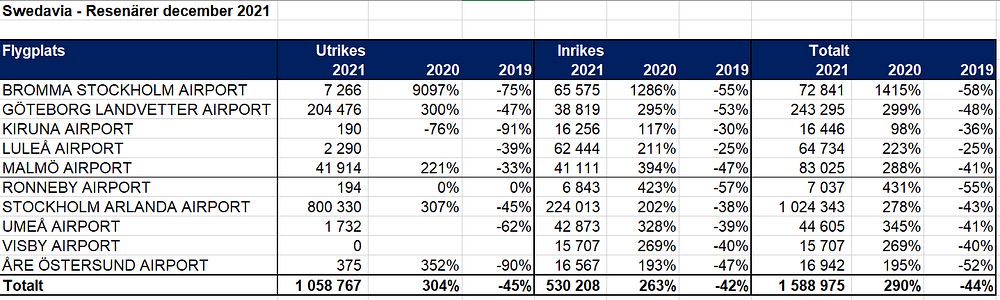


During the month of December, nearly 1.6 million passengers flew via Swedavia's ten airports, a decrease of 44% compared to 2019. For the full year 2021, the number of passengers amounted to nearly 12 million, a decrease of just over 70 percent compared to passenger levels before the pandemic in 2019. 2021 was thus the second year in a row with a strong pandemic effect on air travel, which, despite the recovery during the autumn, remained at levels comparable to air travel in the early 1980s. Since the start of the pandemic, air travel at Swedavia's airports has now decreased by approximately 58 million passengers. Compared to the previous year, which was unaffected by the pandemic during the first months of the year, the number of passengers increased by 16 percent in 2021.
– The development during the end of 2021 was the strongest we have seen since the outbreak of the pandemic, although the recovery slowed down somewhat in December due to the pandemic situation and new restrictions in Sweden and abroad. Despite the strong recovery in the autumn and many bright spots with important investments and new establishments by our customers at Arlanda in particular, 2021 was another year with a strong impact on air travel, which remains at levels from the early 1980s. Although the recovery is expected to continue in 2022, the current pandemic situation and a seasonally weak January mean that we expect weaker development at the beginning of the year, says Jonas Abrahamsson, Swedavia's President and CEO.
Of the 1.6 million travelers in December, 1,059,000 were international travelers and 530,000 were domestic travelers. The beginning of the month was particularly weak, but during and before the Christmas and New Year holidays, demand for air travel was high, both domestic and international. Compared to December 2020, air travel increased by 290 percent in December, but compared to 2019 and before the pandemic, there was a decrease of 44 percent.
For the full year 2021, European traffic with 7,500,000 passengers accounted for the lion's share of international traffic of almost 7,900,000 passengers, but also total air travel during the year of almost 12 million passengers. Domestic travel amounted to just over 4,000,000 passengers. Travel to the rest of the world was just over 380,000 passengers.
Copenhagen, followed by Amsterdam and Frankfurt were the international destinations with the most passengers in 2021 at Stockholm Arlanda Airport, which accounts for the vast majority of international traffic to and from Sweden. Amsterdam and Frankfurt were also the busiest international destinations at Gothenburg Landvetter Airport.
Sweden's largest airport, Stockholm Arlanda Airport, had 1,024,000 travelers in December, which was an increase of almost 280 percent compared to December 2020, but a decrease of 43 percent compared to December 2019. In 2021, the airport had a total of just over 7,500,000 travelers, an increase of 15 percent compared to 2020, but compared to 2019, traveler levels were just over 70 percent lower.
Gothenburg Landvetter Airport had a total of 243,000 passengers in December. Compared to December last year, the passenger increase was almost 300 percent, but a decrease of 48 percent compared to December 2019. The airport had just over 1,900,000 passengers during the full year 2021, which was an increase of 21 percent compared to 2020, but the number of passengers was still just over 70 percent lower than before the pandemic in 2019.
Other Swedavia airports all had significantly better passenger development in December compared to December 2020, but at levels that were significantly below the number of passengers in the corresponding month in 2019. Luleå Airport followed by Kiruna Airport showed the strongest recovery during the month compared to 2019.
Air travel at Swedavia's ten airports has decreased by a total of nearly 58 million passengers since the start of the pandemic 22 months ago.