
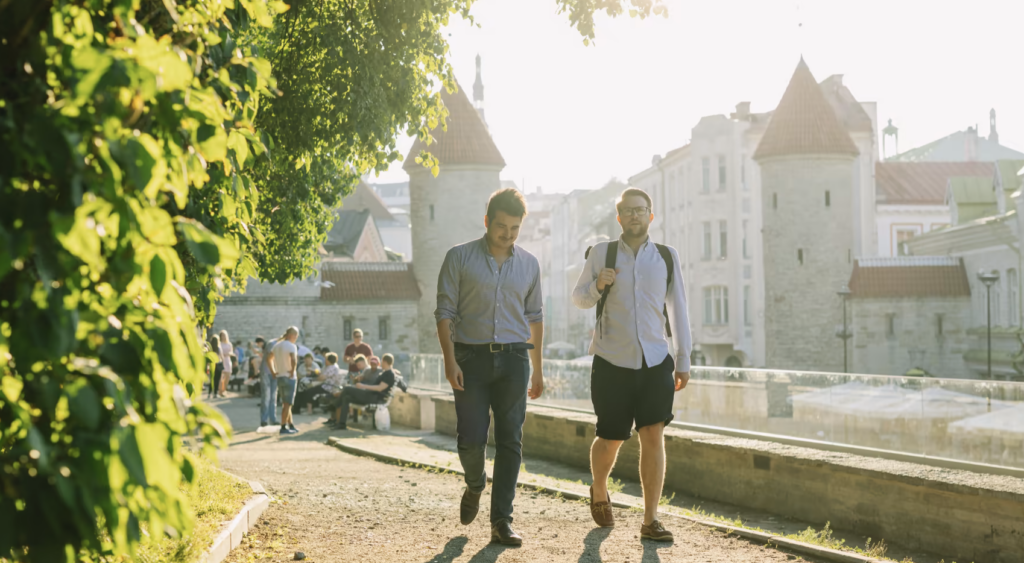
In January 2023, the Estonian capital Tallinn will become Europe's thirteenth Green Capital with the goal of implementing a green transition in the city.
Last September, it was announced that the Estonian capital Tallinn would be the European Green Capital 2023, after competing against Krakow (Poland), Sofia (Bulgaria) and Helsingborg (Sweden). As one of the best-preserved medieval cities in Europe and a UNESCO World Heritage Site, Tallinn is characterised by a rich culture, vibrant city centre and green public spaces. Tallinn impressed the international jury with a systematic approach to green governance and interconnected strategic objectives that reflect the ambitions of the European Green Deal and the UN Sustainable Development Goals.
Tallinn has over 2,100 hectares of protected areas, including nature reserves, parks and even an island. The protected areas with biodiversity cover approximately 20 % and the green areas 65 % of the city's area. Since the beginning of 2022, Tallinn has been leading the European Sustainable Cities Network and implementing the UN Sustainable Development Goals at the local level. Following a referendum in 2013, Tallinn became the first city to introduce free public transport for all residents.
During the year as Green Capital, Tallinn’s main focus is on biodiversity, reducing the city’s carbon footprint and a principled approach to sustainability. The aim is to involve Tallinn’s local community in the city’s development, find opportunities to support and implement green innovation, develop carbon-neutral mobility, circular economy and help the city’s residents better understand the importance of environmental protection. In addition, many Estonian destinations have won awards for their environmental thinking and in the Green Destinations 2021 ranking, six of the world’s hundred most sustainable destinations are in Estonia. Below is a selection of the country’s green destinations.
Start the tour in Tallinn
What better way to start a sustainable journey than in the upcoming European Green Capital? Experience the city's pulse by exploring the exciting restaurant scene, strolling through the city's greenery and visiting the hip Telliskivi Creative City. Most things are within walking distance, but a convenient alternative is to use public transport - good for both your wallet and the environment!
Recharge your batteries in Lahemaa National Park
Take the bus to Lahemaa National Park for hiking and recovery. During its 50-year history, the national park has always been managed with sustainability in mind and as a result, the national park has been awarded the EUROPARC certificate for green tourism since 2019. With 14 lakes, eight rivers, four waterfalls and a rich wildlife ranging from moose to brown bears and lynx, Lahemaa is one of Estonia's top tourist destinations.
Travel back to the Middle Ages in Rakvere
Southeast of Lahemaa National Park lies the town of Rakvere, which attracts visitors with its modern town square and medieval castle, dating back to the 13th century. The castle offers a journey back in time to the Middle Ages with experiences for the whole family: play knight in period costume, learn about the castle's history and taste delicacies from the past.
Embrace island life on Saaremaa
In less than half an hour by ferry and a short drive through Moon Island (Muhu) you will come to Estonia's largest island, Saaremaa (Saaremaa). The ferry is powered by hybrid propulsion, which reduces underwater noise and vibrations, which in turn leads to a better environment for the seals and fish in the sea. Don't miss Kuressaare, the largest city on Saaremaa, where locals regularly perform folk dances dressed in the island's traditional clothing. To experience more of island life, it's easy to get around with the local buses, which are free for everyone - even visitors.
According to the press release.