



Today, AI agents already perform simple tasks and act as assistants to human colleagues to help them achieve more. In the future, multi-agent systems, consisting of many different AI agents that can communicate with each other, will increasingly automate complex tasks. These small code programs use a combination of machine learning and Generative AI to intelligently answer questions or perform complete tasks. They can act independently, proactively solve problems, and at the same time adapt to changes in their environment.
Wolfgang Krips, SVP, Corporate Strategy, Amadeus:
”Due to the importance of unstructured information, the travel industry is part of a group of sectors, along with e-commerce and education, that have the greatest potential to be positively transformed by AI agents and all associated enablers, such as modern data platforms.
From finding the optimal journey to organising airport operations, many of the ”problems” we try to solve in the travel industry share similar characteristics. They require analysis of vast amounts of unstructured data, which is often siloed and difficult to access. Intelligent decisions based on the analysis are then required, resulting in an action – perhaps booking a flight or assigning an aircraft to a specific gate. Downstream systems and stakeholders then need to be updated.
AI agents can automate this type of work. They can flexibly access traveller data, if permitted, and apply increasingly sophisticated reasoning to recommend the best course of action. Crucially, they can also take that action and automatically update the necessary systems. This is why at Amadeus we see Generative AI as a genuine, once-in-a-generation breakthrough.
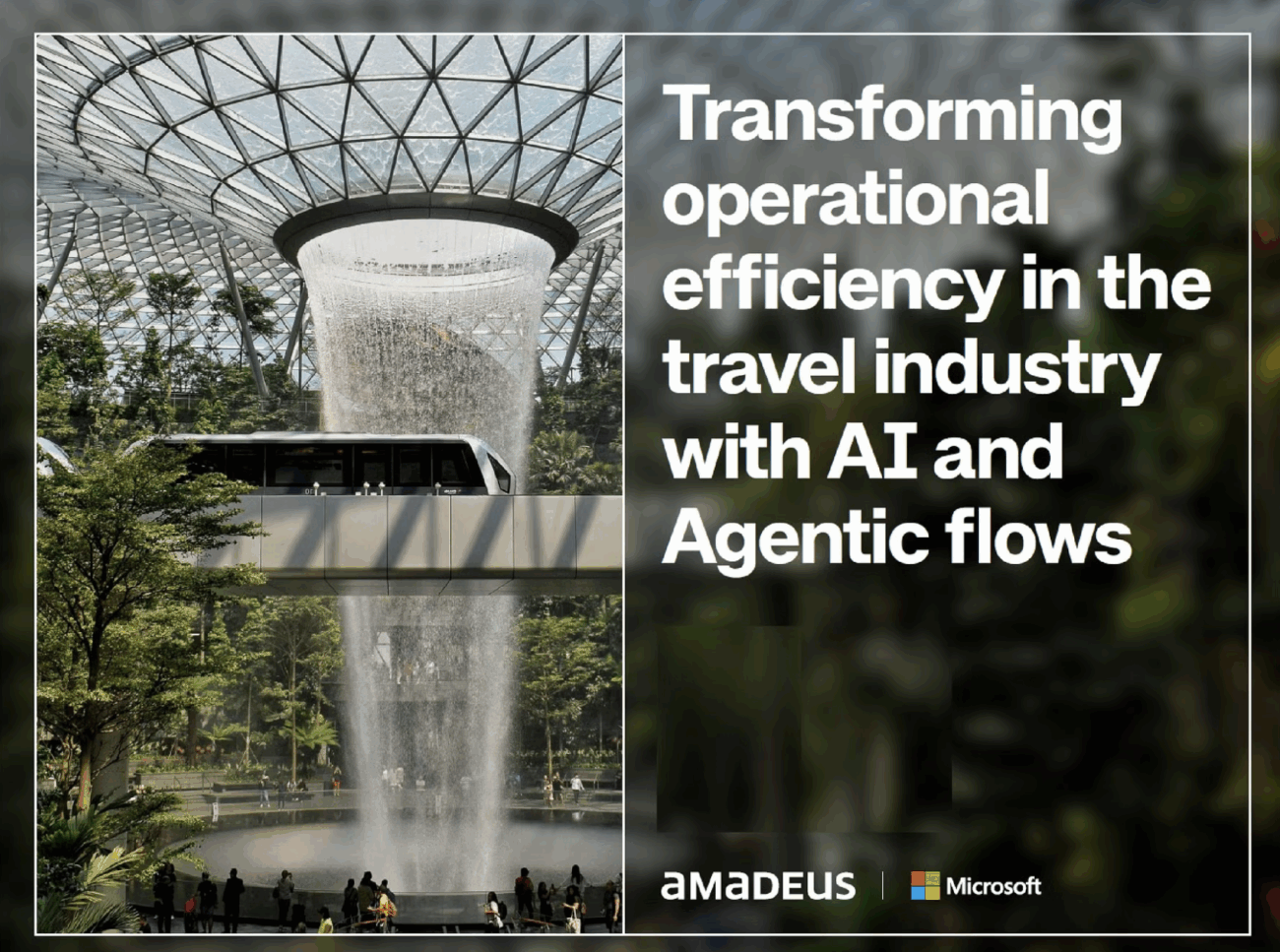
Amadeus and Microsoft have recently developed related which is investigating the potential of agent-based AI in the travel industry.
Studies focus on use cases for AI agents driving operational efficiency for airlines, airports, travel sellers, and hotel and restaurant businesses. It provides initial details on the first round of six AI agents which are explored for the first time in Amadeus's solution portfolio. Although these initial agents tend to be assistants rather than fully autonomous, some of them are already in operation and delivering value today.
1. Aviation regulations expert
One of the most common and time-consuming requests that travel agents handle is travellers” queries about their flight bookings. Answering simple questions such as ”how much does it cost to change my ticket?” or ”when is the last date to make a change?" can take up to 10 minutes.
Travel agencies can now answer such questions in an instant by chatting with an AI agent. The AI agent has been trained on airline fare rules for both types of content – sourced from EDIFACT (technology traditionally used in GDS) and NDC (New Distribution Capability) – using data from ATPCO, PDF documents directly from airlines, airline B2B portals, and Amadeus. This allows it to provide highly relevant answers, negating the need for travel agents to call airlines.
2. A PNR guide
This AI agent helps human travel agents respond more quickly to booking queries and acts as a guide for Passenger details (PNR). You can chat with this agent instead of analysing a PNR and can also see which of your colleagues have made previous changes to a PNR.
3. An assistant that monitors your inbox
This AI agent has been designed specifically to act as an assistant that reads every incoming email a travel agent receives to check that all necessary information has been provided. The AI agent can analyse the email text to detect the traveller's intent and any missing information. Subsequently, an email response is created which is reviewed by the travel agency's staff before being sent to the traveller. By automating this task, human agents can spend more time advising customers and selling more.
4. Specialist in cross-selling and up-selling
This agent provides cross-selling and up-selling recommendations, making it easier to add ancillary services and increase the total basket size. The agent monitors offers created for the traveller and can prompt the human travel agent to offer relevant add-ons.
For example, if a premium economy flight ticket has been offered, the AI agent can detect that the traveller can fly in business class for a small additional cost if the departure is delayed by two hours. During a phone call, the human agent receives this information via Selling Platform Connect. Likewise, the agent can continuously monitor flight and hotel prices to ensure the best prices and value are always offered.
5. Garv – environmental consultant for airports and airlines
Garv is an AI agent developed for airport operations teams, enabling users to query complex operational data through natural language or speech and receive contextual, actionable insights. For example, when asked to analyse passenger processing times by airline for the month of March, Garv delivers accurate results, identifies anomalies, and explains reasons for unusual patterns, helping teams perform root cause analysis, address underlying issues, and optimise airport capacity and passenger flow.
6. Amadeus Advisor – a hotel and restaurant analyst
The first of several AI agents designed to increase the value that hotel and restaurant businesses can derive from data analysis. They can simply ask the agent and receive an immediate answer in the form of a data visualisation and a precise text-based response. Subsequent data visualisations can form the basis for further action, such as a focused sales campaign targeted at specific agencies or a new marketing campaign.
”We have only just begun to scratch the surface of what is possible. Agentic AI will deliver entirely new business models and significant efficiency gains. By collaborating with our customers and strategic partners like Microsoft, we can deliver positive impacts for both travellers and our industry, benefiting from the very latest technological advancements. says Stig Thorup, Commercial Director, Travel Sellers, Amadeus in Scandinavia We strive to create a future where technology enhances people's experiences and makes them more personal, efficient, and sustainable. And we are committed to doing so in a way that respects privacy, builds trust, and aligns with societal values.