



This report examines the critical aspects of infrastructure in Sweden that impact the travel and hospitality industry. By gathering insights from leading decision-makers in the industry, a detailed analysis of current infrastructure challenges and strategic recommendations are presented.
for future improvements.
Target group:
The report is aimed at decision-makers in the transport and tourism sector, including authorities, politicians and industry players, to inform and guide future infrastructure investments and policy changes.
Introduction and purpose:
Sweden's travel and tourism industry plays a central role in the country's economy and cultural development. To ensure continued strong growth in this sector, it is crucial to adapt and improve the infrastructure to meet both current and future needs. There is broad political consensus that Sweden faces a significant need to upgrade its transport infrastructure. Through this survey, we aim to understand what the travel industry considers to be the most important focus areas for strengthening the Swedish tourism and travel industry. Through a survey, we have gathered insights from leading decision-makers in the sector. The participation and contributions of these key players are invaluable in helping us to
formulate recommendations for decision-makers, authorities and politicians. The report presents the results of the survey, analyses of the collected data and concrete recommendations for improving the infrastructure and thereby supporting the growth and development of Sweden's tourism industry.
About the survey:
The survey was conducted between April 17 and May 14 with approximately 500 participants from travel agencies, tour operators, transport, accommodation and destination companies. The majority of respondents (56 percent) were CEOs or representatives of the management team. The majority have their clientele spread throughout Sweden and/or internationally. The respondents are members of the Swedish Travel Industry Association (SRF), the Swedish Business Travel Association (SBTA) and the Nordic Bench respondent panel.
Perception of Swedish infrastructure today:
The survey included an examination of how different infrastructure elements are perceived today, with respondents being asked to indicate on a scale of 1 to 5, where 1 is ”Very bad” and 5 is ”Very good”, how well they perceive the different elements to be functioning today. The results show that although airports and airlines are considered to be functioning quite well compared to other elements, with average ratings of 3.62 for airports and 3.20 for airlines, there is still some way to go to a high rating on the scale. This suggests that there is room for significant improvement. Airport transfers receive an average rating of 3.24, which also indicates that there is potential to further improve these services to better meet customer needs. Later in the survey, it emerges, among other things, that there is dissatisfaction with the high prices for transfers.
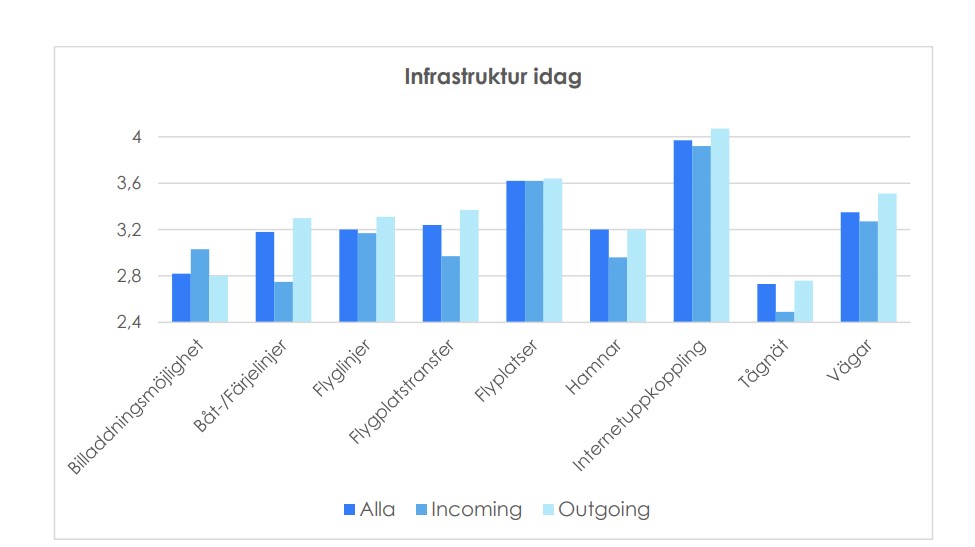
When it comes to the rail and road networks, a mixed picture is given. The rail network receives the absolute lowest average rating in the survey, at 2.73, which points to a high level of dissatisfaction among respondents, especially those focused on receiving international visitors. The road network receives a slightly higher rating of 3.35 but still shows that improvements are needed to fully support both outgoing and incoming activities. Car charging facilities receive an average rating of 2.82, and a large proportion of respondents, 41 percent, indicated ”no opinion”, which may indicate a lack of awareness or use of these facilities. However, among those who do have an opinion, a very low rating is given. For other infrastructural elements such as ports, boat and ferry lines and internet connectivity, varying degrees of satisfaction are observed. Internet connectivity ranks highest with an impressive average rating of 3.97, which suggests that this service largely meets current requirements. However, both ports and boat/ferry lines receive lower average ratings with a significant proportion of respondents indicating ”no opinion”, 45 percent for ports and 36 percent for boat/ferry lines, indicating a potential for increasing awareness and use of these means of transport.
Infrastructure and its impact on the travel and tourism industry
The survey shows that accessibility to public transport such as trains, buses and flights is particularly important for companies in the travel and tourism industry, with 67 percent of respondents emphasizing this. The range of flight routes to and from Swedish airports is also critical, with 40 percent of respondents stating that restrictions here have sometimes prevented their business from developing. When comparing companies that mainly serve international travelers (incoming) with those that mainly focus on the Swedish market (outgoing),
clear differences in priorities and needs emerge. Companies with a focus on incoming customers value accessibility to public transport more highly (79 percent) than those that primarily serve the Swedish market (61 percent). These companies also emphasize the importance of roads more strongly (34 percent compared to 16 percent). The importance of reliable internet connectivity and well-developed charging infrastructure is also somewhat higher among companies that serve foreign travelers, with 29 percent and 29 percent respectively.
27 percent compared to 14 percent and 11 percent among those focusing on Swedish travelers.
Infrastructure deficiencies have been a major obstacle to expansion and development, especially among companies in the incoming segment (37 percent). Access to logistics infrastructure such as ports, airports and railways is also considered more important by companies with an international focus (26 percent) compared to 20 percent in the outgoing segment. Access to air routes is something that is very critical for travel companies targeting the Swedish market, with 51 percent reporting that this has sometimes
limited their activities.
Urgent infrastructure investments
The survey identifies the most urgent infrastructure investments that are
necessary to strengthen the travel and tourism industry. Removing the maintenance debt on
railway is a priority for almost 60 percent of respondents, while almost
half see a need to expand the railway network to include more locations. In order
after that, there is a significant proportion who want to see an upgrade of the road network and
modernization of Arlanda airport.
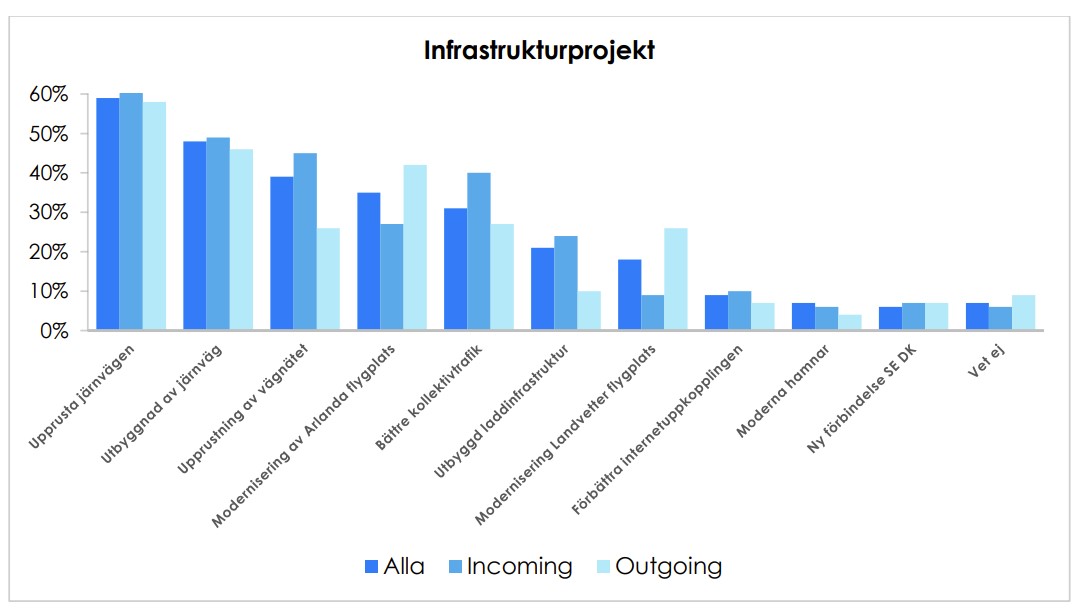
As previously stated, different types of companies in the tourism sector prioritize different aspects of infrastructure. Companies that handle international guests emphasize the need to improve the road network, which is considered by almost half of these companies compared to 26 percent among others. Incoming companies also highlight the importance of improving public transport throughout the country, which 40 percent see as necessary. In addition, significantly more companies with an international focus (24 percent) believe that a
expanded charging infrastructure is important, compared to only 10 percent of the other companies. Companies that primarily target the Swedish market also prioritize modernizing and expanding Arlanda (42 percent) and Landvetter Airport (26 percent). This underlines their need for more efficient flight connections in order to have a good offer for their customers. Differences are also observed in how internet connectivity is valued; a smaller proportion of incoming companies (10 percent) see this as a prioritized improvement compared to those that focus on the Swedish market (7 percent). However, prioritizing new fixed connections between Sweden and Denmark and modernization of ports is considered to be of similar importance for both groups.
Free text answer: Suggestions on how infrastructure measures
The survey included a question where respondents were given the opportunity to provide suggestions on how infrastructure could be improved to better support the tourism and travel industry. Here is a summary of the most prominent suggestions:
1. Railway infrastructure:
o Focus on removing the maintenance debt on the railway to ensure that more trains run on time.
o Expand the railway network so that more locations can be reached by train and high-speed trains can operate.
2. Roads and public transport:
o Improve the road network, especially in rural areas, to ensure that the roads are in better condition.
o Introduce better public transport in rural areas, including on-demand bus services.
o Improve public transport throughout the country to facilitate travel for both domestic and foreign tourists.
3. Airports and airlines:
o Modernize, upgrade and expand Arlanda and Landvetter airports to increase capacity and improve service.
o Increase the number of direct routes from Swedish airports to both domestic and international destinations.
o Subsidize Arlanda Express to make it cheaper to travel from Arlanda to Stockholm city.
4. Charging infrastructure and environmental zones:
o Expand the charging infrastructure for electric cars and create more high-capacity charging stations.
o Slow down the introduction of environmental zone 3 until the technology is in place or provide temporary exemptions for buses.
5. Tourist buses and service:
o Create more parking opportunities for charter buses in metropolitan areas and improve accessibility for people with disabilities.
o Build more parking spaces and service facilities for tourist buses, including access to laundry and toilet facilities.
6. Internet and digital booking:
o Improve internet connectivity in parts of Norrland and other sparsely populated areas.
o Develop better booking systems where domestic and international travel can be booked simultaneously, and enable the combination of train and flight bookings.
Summary
The conclusion of this report is clear: there is a significant need for infrastructure investment to support the growth and development of Sweden’s tourism and travel industry. By analyzing insights from leading decision-makers in the sector, we have identified several key areas that require attention and action.
• Infrastructure challenges: The report shows that several infrastructure elements, including the rail network, road network and charging infrastructure, are perceived as deficient. Improvements are needed to meet both domestic and international needs.
• Priorities and needs: Depending on whether companies primarily serve international or Swedish travelers, their priorities and needs differ. This underlines the importance of designing measures that take into account different segments within the travel and hospitality industry.
• Suggestions for action: Respondents' suggestions for improvements span a wide spectrum, from eliminating the maintenance debt on the railways to modernizing airports and improving digital booking systems. These suggestions point to concrete actions that can be taken to strengthen the industry.
In conclusion, it is clear that investment in infrastructure is crucial to ensure sustainable growth in the travel and tourism industry in Sweden. By addressing the identified challenges and implementing the proposed measures, Sweden can remain an attractive destination and continue to benefit from the economic and cultural importance of tourism.
Report content
This report is an overall summary of the survey "The visitor industry's perception of Swedish infrastructure".
Use of this information
The information in this report has been primarily prepared on behalf of a client. The survey and this report aim to provide insight into how Swedish decision-makers in the tourism industry perceive Swedish infrastructure today and what development they would like to see.
Survey implementation and selection
The survey was conducted between April 17 and May 14 with approximately 500 participants from travel agencies, tour operators, transport, accommodation and destination companies. The majority of respondents (56
percent) were CEOs or representatives of the management team. The majority have their clientele spread throughout Sweden and/or internationally. The respondents are members of SRF, SBTA and the Nordic Bench respondent panel.
Nordic Bench AB
Nordic Bench AB is an independent consulting and analysis company with a focus on the Nordic travel and meetings industry. Nordic Bench conducts, among other things, the following recurring surveys:
- NPS Benchmarking in the travel industry
- Swedish Private Travel Barometer
- Business Travel Index –
Quarterly forecast - Conference & Meeting Barometer
Nordic Bench also manages the Nordic region's largest completely independent business travel panel, consisting of approximately 12,000 qualified business travelers and decision-makers. Further information about Nordic Bench.
NUMBER OF PARTICIPANTS
472
INDUSTRY SEGMENT DISTRIBUTION
Tour operator 25%
Travel agency 22%
Conferences, meetings and events 10%
Accommodation 6%
Flight 6%
Train 1%
Bus 3%
Destination organization 8%
Tourist attraction 2%
Other in the industry 9%
Other 8%
BUSINESS FOCUS 22%
Incoming 16%
Outgoing 43%
Mixed 30%
Other 12%
POSITION/TITLE
Management group 18%
CEO or equivalent 38%
Other management position 14%
Travel manager/Travel Manager 12%
Other 17%
CUSTOMER RECEPTION AREA
All of Sweden 66%
Abroad 33%
Upper Norrland 3%
Central Norrland 1%
North Central Sweden 4%
Eastern Central Sweden 7%
Stockholm 21%
West Sweden 12%
Småland with the islands 5%
Southern Sweden 9%
Published by:
Swedish Travel Industry Association (SRF)
Swedish Business Travel Association (SBTA)
Nordic Bench