




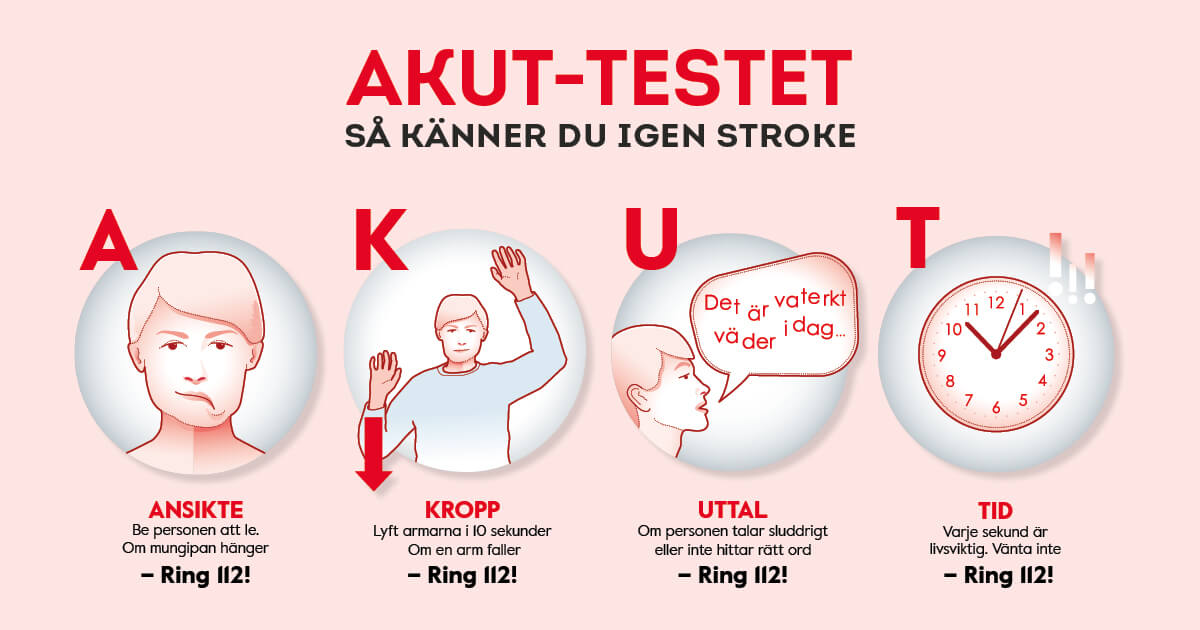
Stroke is one of the most common causes of death and disability in Sweden. Approximately 25,500 people are affected each year, according to the National Board of Health and Welfare. If more stroke patients had faster access to care, many lives could be saved. Therefore, the Swedish Heart and Lung Foundation urges more people to learn to recognize a stroke through the AKUT test.
– When a stroke occurs, emergency treatment is required to reduce the risk of brain damage and increase the chance of survival. Unfortunately, only one in three people affected reaches hospital within three hours. If the entire population of Sweden learns the symptoms of stroke, we can save more lives and increase the chances of more healthy years for those who fall ill, says Kristina Sparreljung, Secretary General of the Swedish Heart and Lung Foundation.
When someone has a stroke, emergency treatment is required to reduce the risk of brain damage and increase the chance of survival. Quickly recognizing the symptoms of a stroke using the AKUT test and calling 112 can be the difference between life and death. See the fact box about the AKUT test below.
In April last year, the Swedish Heart and Lung Foundation conducted a survey that showed that only one in four Swedes, 26 percent, knows the signs of stroke through the AKUT test.
“If the public's knowledge of the symptoms of stroke were to increase, the quality of life for those affected would most likely also increase,” says John Pernow, professor and chairman of the Swedish Heart and Lung Foundation's research council.
With nearly one million hospital days per year, stroke is the single disease that accounts for the most hospital days in Swedish hospitals. One in three sufferers has been able to return to the life and activities they had before the stroke. At a three- and five-year follow-up, two-thirds of those affected have still not been able to fully return to the life they had before the stroke.
Facts: The ACUTE test (Source: Swedish Heart and Lung Foundation)
• At the slightest suspicion of a stroke – call 112!
• One way to check if a person may have had a stroke is to do the so-called ACUTE test (Face Body Speech Time). If someone suddenly starts behaving differently and you suspect a stroke, ask the person in question to perform the following actions:
A – Face. Ask the person to smile. With a stroke, one corner of the mouth does not always smile.
K – Body part. Ask the person to hold their arms straight up. During a stroke, one arm often drops down.
U – Pronunciation. Ask the person to say a simple sentence such as ”the weather is nice today.” In stroke, pronunciation is often slurred.
T – Time. Every second counts to save lives.
Facts: How to reduce your risk of stroke (Source: Swedish Heart and Lung Foundation)
• Keep track of your blood pressure – High blood pressure is considered one of the common diseases and in Sweden, more than half of everyone in the 65–85 year age group has high blood pressure.
• Eat heart-healthy foods – Eat at least 500 grams of vegetables and fruit per day, which is equivalent to about two handfuls of vegetables, root vegetables and legumes and two fruits. Whole grains can reduce the risk of type 2 diabetes and cardiovascular disease and also help maintain weight thanks to fiber, which fills you up. A reasonable amount is 70 grams for women and 90 grams for men, which is equivalent to, for example, two crispbreads and one portion of whole grain pasta per day.
• Cut down on the salt – Eating less salt is part of the dietary advice to lower high blood pressure. An adult should not eat more than 6 grams of salt per day, which is about a teaspoon. But most people eat significantly more than that, often without being aware of it. Most salt is hidden in foods such as ready meals, cold cuts and cheese. Even food in restaurants is often oversalted. It is advisable to choose foods that are Keyhole-marked, as they contain less salt.
• Stop smoking – Tobacco smoking is the single greatest risk factor for lung, heart and vascular diseases. There is nothing that has such a rapid and positive effect on health as quitting smoking.
• Physical activity – It doesn't take sweaty, hard workouts at the gym to protect your heart, a pleasant 30-minute walk a day is better than nothing. For example, vacuuming the house, working in the garden and choosing the stairs over the elevator makes a big difference in the long run, a bigger difference than going to the gym a couple of times a week and being still the rest of the time. Start gently and increase gradually. Physical activity has a positive effect on all underlying risk factors for cardiovascular disease.
Facts: The 12 most important risk factors for stroke (Source: Swedish Heart and Lung Foundation)
• High blood pressure
• Excessive salt intake
• Smoking
• Atrial fibrillation
• Diabetes
• Low physical activity
• High blood fats
• Previous stroke or TIA
• Old age
• Heredity of cardiovascular diseases
• High alcohol consumption
• Depression and psychosocial stress
According to the press release.