



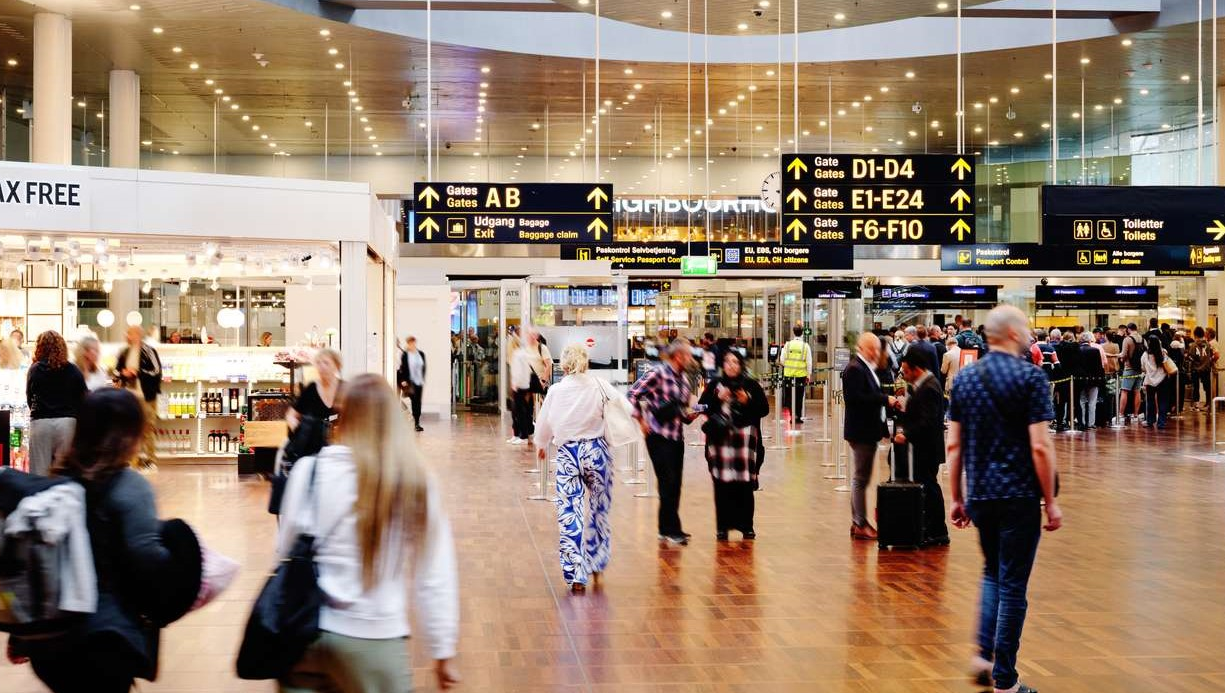
Copenhagen Airports A/S comes out of the first quarter with a pre-tax profit of DKK 104 million. More and more travelers are choosing to fly to and from Copenhagen Airport and during the first quarter of the year, 6.2 million passengers passed through the terminals – an increase of seven percent compared to last year.
2025 has started well at Copenhagen Airport. It has been 100 years since the first plane took off from a grassy field on Amager, which is now Denmark's largest airport. In the first three months of the year, 6.2 million passengers travelled through the airport, which is seven percent more than the same quarter last year – when Easter was even in March, while this year it was in April.
“There is still a desire to travel around the world, including international tourists coming to Copenhagen and the rest of Denmark. Even without the many Easter travelers that we saw as late as April, 6.2 million passengers passed through the airport during the first three months of the year,” says Christian Poulsen, CEO of Copenhagen Airport.
Copenhagen Airports A/S comes out of the first quarter with a profit of DKK 104 million before tax and a total turnover of DKK 1,075 million. This is an improvement compared to last year, when the first quarter resulted in a profit of DKK 98 million before tax and total revenues amounted to DKK 1,036 million.
”"I am pleased with the results for the first quarter, which are as expected. The number of passengers is in line with our forecast and the first months of the year at the airport are traditionally quieter than the summer program that came into effect on March 30 with more than 300 direct routes from Copenhagen to the rest of the world. Whether the geopolitical situation affects international travel patterns will not become clear until the next few months," says Christian Poulsen.
Increased turnover
Total revenue during the first quarter of the year amounted to DKK 1,075 million, which is an increase of four percent compared to the previous year.
The airline's revenue from air traffic reached DKK 632 million in the first quarter, which is DKK 24 million more than the previous year, corresponding to an increase of four percent.
Non-aviation-related revenues are revenues from shopping malls, parking operations, rental of buildings and premises and hotels at the airport, which ended at DKK 443 million, an increase of four percent compared to the previous year. Growth has been negatively affected by the temporary closure of several shops and eateries due to the ongoing construction project for the expansion of Terminal 3.
Growth on intercontinental routes
The total number of passengers during the first quarter has increased compared to the previous year, and intercontinental routes in particular have shown positive development. Here, the number of passengers has increased by a full 14 percent compared to last year.
– We are pleased with the development we see on the long-distance routes to and from Copenhagen. The vast majority of the 32 long-distance routes are running well and this helps to consolidate our position as an important transport hub in northern Europe, says Christian Poulsen.
The five most popular long-haul destinations during the first three months of the year are: Doha, Dubai, Bangkok, New York and Los Angeles.
”"On routes to and from the USA, there were 19 percent more passengers during the first quarter compared to the same period last year. This is mainly due to SAS having chosen to concentrate the majority of its intercontinental traffic to Copenhagen and making Copenhagen Airport its global hub. More than half of the passengers are stopovers flying into Copenhagen from Scandinavia and Europe and on to the USA – or Americans using the good route network between a number of American cities and Copenhagen," says Christian Poulsen.
Important steps in the aviation transformation
The increasing number of passengers leads to a greater climate impact and the transformation of aviation is one of the most important tasks for the industry. Copenhagen Airport has an ambitious goal of reaching net zero for the airport's own operations by 2030. This includes greenhouse gas emissions from the airport's vehicles and heat and electricity consumption.
The goal is for Copenhagen Airport to have reduced emissions from its own operations by at least 90 percent by 2030 compared to 2019 levels. The remaining emissions will be compensated through investments in climate credits.
– We are well on our way to reaching Net Zero for the airport's own operations by 2030. But it is the aircraft's use of fossil fuels and the emissions that come with them that are the industry's biggest challenge. Therefore, it is gratifying that 2025 is a year where something concrete is actually happening on that front, says Christian Poulsen.
Since the annual report, there has been a requirement from the EU that two percent fossil-free fuel must be mixed in all planes taking off from an airport in an EU country. The requirement for mixing is increasing continuously over the years, so that by 2050 there is a requirement for 70 percent fossil-free fuel. In addition, the Danish passenger tax has come into force, so there is a tax on all travelers flying from a Danish airport of between 30 and 300 Danish kroner per trip, depending on the length of the trip. Approximately half of the amount is earmarked for the transformation of aviation.
– I am convinced that the EU's requirements will have a positive impact on the demand for fossil-free fuels. But there is still a challenge in the industry with the price. The new type of fuel is significantly more expensive to produce and therefore an even greater political will is needed to promote the development and production of fossil-free fuels, says Christian Poulsen.
Outlook for 2025
In 2025, Copenhagen Airport continues to expect that the increase in passenger numbers will continue, which will lead to higher revenues.
Copenhagen Airport expects passenger numbers to increase to approximately 32 million by 2025, which is expected to result in revenue growth of eight percent.
If the number of passengers reaches around 32 million, it is likely that the pre-tax profit for the whole of 2025 will be between 1.45 and 1.65 billion Danish kroner.
However, the outlook for financial performance is uncertain due to geopolitical and macroeconomic influences. A deterioration in these factors could have a negative impact on the desire to travel and thus economic expectations.