



Copenhagen Airports A/S comes out of the first half of the year with a pre-tax profit of DKK 595 million. The desire to travel in the world is still high and during the first six months of the year a record number of travelers passed through the terminals.
Copenhagen Airport's 100th anniversary looks set to be a record year in the airport's history. During the first six months of the year, 14.9 million passengers travelled through the terminals, which is eight percent more than the first half of last year and the highest number of passengers ever.
“There is a great desire and need to travel and we see a continued increase in the number of travelers using the airport. This applies to both Danish travelers, who make up about a third of all travelers, and international travelers who are visiting Denmark or are on their way out into the world,” says Christian Poulsen, CEO of Copenhagen Airport.
Copenhagen Airports A/S comes out of the first half of the year with a profit of DKK 595 million before tax and a total turnover of DKK 2,541 million. This is an improvement compared to last year, when the first half resulted in a profit of DKK 491 million before tax and total revenues amounted to DKK 2,355 million.
”"I am pleased with the results for the first half of the year. This is as expected and the number of travelers is in line with our forecast. We do not yet see that the geopolitical situation has significantly affected international travel patterns, but we are of course keeping an eye on developments," says Christian Poulsen.
Increased turnover
During the first six months of the year, total revenue at the airport amounted to DKK 2,541 million, which is an increase of eight percent compared to last year.
The airline's revenue from air traffic reached DKK 1,548 million in the first half of 2025, which is DKK 122 million more than the previous year, corresponding to an increase of nine percent.
Non-aviation-related revenues, i.e. revenues from shopping centers, parking operations, rental of buildings and premises and hotels at the airport, ended at DKK 993 million, an increase of seven percent compared to the previous year. Growth is negatively affected by the temporary closure of several shops and eateries due to the ongoing construction project for the expansion of Terminal 3, which is due to be completed in 2028.
More trips via Copenhagen
An increasing proportion of passengers at Copenhagen Airport are transfer passengers who use the airport as a stopover on their journey further afield. During the first half of the year, 3.3 million transfer passengers passed through the airport, which is a full 23 percent more than the same period last year.
“The increase in transfer passengers means that we are consolidating our position as Northern Europe's largest transport hub. More than one in five travelers who pass through the airport are on a stopover and on their way out into the world,” says Christian Poulsen.
Nine out of ten transfer passengers arrive via Copenhagen on SAS flights from Scandinavia, the Baltics, Northern Europe and the rest of Denmark, among other places. The large proportion of transfer passengers contributes to more intercontinental routes to and from Copenhagen.
“Good connections to the whole world help attract foreign companies and workers to Denmark, just as new direct routes make it easier for Danish companies to get to the rest of the world. This has value for the whole of society,” says Christian Poulsen.
New routes and destinations
More airlines and passengers are choosing to fly to and from Copenhagen Airport. During the first six months of the year, 29 new routes were opened, bringing the total number of routes from Copenhagen to 171 different destinations to 334.
– We are constantly working to be an efficient and attractive airport for both airlines and travelers. So we are of course very pleased that airlines are establishing new routes from Copenhagen, with several of the routes even going to completely new destinations. This gives travelers from Denmark and southern Sweden more opportunities to get out into the world – and just as importantly, it makes it easier for foreign tourists and business travelers from all over the world to get to Copenhagen and the rest of Denmark, says Christian Poulsen.
The vast majority of new routes are within Europe, which accounts for more than 85 percent of total traffic from Copenhagen Airport.
Progress for several airlines
SAS, Norwegian and Ryanair, the three largest airlines at Copenhagen Airport, are all experiencing an increase in the number of passengers to and from Copenhagen. The three companies' combined passenger share during the first half of the year amounted to 62 percent – an increase from 57 percent in the same period last year.
– It is of great importance to us that the airport's airlines are now growing. It is very positive and we look forward to welcoming even more travelers. All three companies are based in Copenhagen, so it helps to create more jobs in and around the airport as it progresses, says Christian Poulsen.
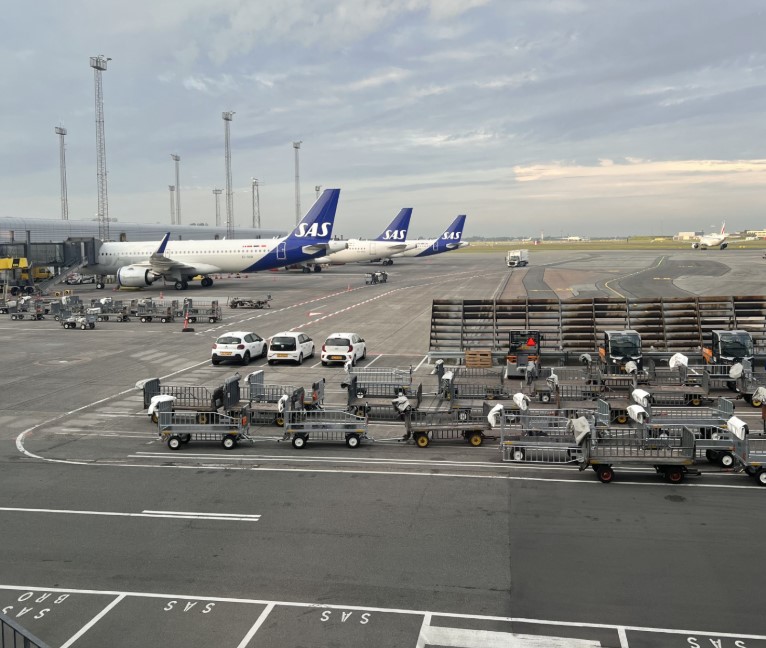
SAS has chosen to make Copenhagen Airport its global hub and the company has so far increased its presence at the airport with 18 new routes and more departures on a number of existing routes. During the first six months of the year, SAS increased its share of passengers at the airport by 22 percent compared to the previous year, so that the company accounted for 37 percent of the total traffic at Copenhagen Airport during the first half of the year.
New security check with computed tomography scanners
Copenhagen Airport is constantly developing to remain an attractive and efficient airport. In early May, the first five new queues in the airport's security checkpoint opened with new technology and 3D scanners.
The inauguration is a major step towards the security checkpoint of the future, which will be completed next spring with a total of 20 new queues, of which six additional lanes will be ready for travelers as early as November.
Among the new technological solutions are computed tomography scanners that can generate 3D images of the contents of passengers' carry-on luggage. This makes it easier to identify any items that are not allowed to fly, while also giving passengers an easier and smoother route through security, where they can leave all their technology in their carry-on luggage, and keep their watch and belt on.
Biodiesel and electricity from offshore wind turbines
The increasing number of passengers leads to a greater climate impact and the transformation of aviation is one of the industry's most important tasks.
– We have an ambitious goal to reduce emissions from our own operations by at least 90 percent by 2030 compared to 2019 levels. We will compensate for the remaining emissions through investments in recognized climate credits, says Christian Poulsen.
The target covers emissions from energy consumed in the airport’s buildings, vehicles and equipment. Copenhagen Airport is in the process of electrifying vehicles and equipment and on July 1, the airport switched to using HVO biodiesel in its own diesel vehicles, such as large fire engines and snowplows. HVO biodiesel is made from residual oil and has a climate impact that is up to 90 percent lower than fossil diesel.
In addition, since the beginning of the year, the airport's electricity consumption has been covered with renewable energy. This is done via a so-called Power Purchase Agreement with Vattenfall, which is connected to two Danish wind farms in the North Sea.
– We are well on our way to achieving our 2030 targets with initiatives that reduce the airport's own emissions. But the biggest challenge for the industry is emissions from aviation, which can only be reduced by using fossil-free aviation fuels. Developments are going in the right direction, but they are slow and require political will to promote the production of fossil-free fuels, says Christian Poulsen.
State purchase of the airport
In December last year, the Ministry of Finance announced that a political agreement had been reached whereby the Danish state would take over the majority of the shares in Copenhagen Airports A/S.
The European Commission has approved the acquisition by the Danish State of a controlling interest in Copenhagen Airports A/S. ATP, which is currently the majority owner of the airport, has announced that the conditions for the transfer of the controlling interest in Copenhagen Airports A/S to the Danish State have been met.
ATP expects that the Danish state will make a mandatory offer to other shareholders to purchase shares during October.
Outlook for 2025
Copenhagen Airport expects that growth in passenger numbers will continue throughout the rest of the year and reach approximately 32 million by 2025, which is expected to result in revenue growth of eight percent.
If the number of passengers reaches around 32 million, it is likely that the pre-tax profit for the whole of 2025 will be between 1.45 and 1.65 billion Danish kroner.
However, the outlook for financial performance is uncertain due to the geopolitical and macroeconomic situation, which could potentially negatively impact travel demand and thus financial prospects.
According to the press release.